Saturday, while working on my next presentation, I began tearing up. I felt the strong presence of my childhood friend Karen Greening. She had passed away years ago the Tuesday morning after the May long weekend. Doing the math, I realized it is twenty-five years ago today. Twenty-five years? How is that possible?
Karen was a few years older than me. She had severe cerebral palsy – she didn’t have any purposeful movement in her limbs, which were in constant motion, and she had no verbal communication. But she had beautiful blue eyes and a big smile.
We met when Mom began teaching Karen’s special ed class. Mom taught these non-verbal kids to communicate using Bliss symbols. Using a headstick, Karen was able to communicate, in a limited way, by pointing to the grid of Bliss symbols fastened to her wheelchair tray. She was also able to type, in the same manner, on a Smith Corona typewriter. It was painfully slow, but it was one of the few things she could do on her own.
Before the homework began piling on for me, I frequently took the school bus home with her on Friday afternoons to spend the weekend with Karen. It was the only time I had chocolate milk – such a treat! Mrs. Greening became my second mom.
Communicating was interesting; the two of us didn’t have lengthy, nonsensical chats. I couldn’t easily decipher a head shake from a head nod, so I had her roll her eyes for no, which she was great at doing. Like she understood Glenda-ish any better! Simply being together and watching television was often enough.
At some point, Mr. Greening built an in-ground pool in their large backyard. Strapped to an inner tube, the pool was the one place that Karen could experience independent mobility. She loved splashing about.
On summer days, Mom drove me and my three brothers over to the Greenings to spend the day in their pool. Karen loved watching the antics of the three boys. They kept her entertained. Spending the day with her was a good way to break up the boredom and loneliness that we both experienced during the summers.
Once I began high school, I rarely had a weekend free from homework. Time spent with Karen was limited to a get-together at Christmas and pool days during the summer. I felt like I was living two lives: my able-bodied life at a regular high school and my disabled life with Karen and horseback riding for the disabled, and the two lives hardly ever intersected.
In my first year of Grade 12, Karen, in her early twenties, was experiencing complications due to her scoliosis. Because of her back curvature, her food wasn’t digesting properly. Every night when Mrs. Greening put her to bed, she vomited. This lasted for months. Karen was scheduled for surgery to have a Harrington rod inserted to straighten her spine – a complicated yet standard procedure for people with limited mobility.
I vaguely recall both families getting together at Christmastime, 1983. Then Mom heard from Mrs. G a couple of times, saying Karen’s surgery date had been postponed yet again. Karen still wasn’t keeping much food down.
The next call came the Tuesday morning after the Victoria Day long weekend, while we were getting ready for school. That was highly unusual because our phone never rang that early. I immediately knew something was wrong. Mom told us the news once she hung up the phone.
Karen had had the surgery and had pulled through okay. She had even sat up a bit in the hospital bed. But, then, that morning she went into cardiac arrest. She didn’t pull through. She died
Understandably, I was quite upset with just losing friend. But, for some unknown reason, my family didn’t stop for death. Off to school I went, in shock and dazed. I told one friend about Karen’s death. With my Grad Banquet and Dance that Friday, the week was one hell of an emotional rollercoaster ride for me.
After that Tuesday morning, Karen wasn’t spoken of much again. Her parents, my second mom, were never heard from again, and there was no mention of a funeral or a memorial service. But I didn’t forget her. I know she is one of my guardian angels.
Over time I tried rationalizing that Karen became tired with needing everything done for her and she moved on to a place where she could experience complete freedom.
Then, while learning about anorexia in my psychology courses at university, I wondered if her nightly vomiting had the same effect on her body as an eating disorder would have had. Her heart wasn’t strong enough to withstand the surgical assault on her weakened body.
Now, I am thinking perhaps the reason why she died is a bit of both – or something else I yet to understand.
Whatever the reason for her death, Karen is never too far my thoughts, as is Chris – a family friend killed by a drunk driver, but that is another story. Today is Karen’s day to be remembered.
I have often wondered how Karen would have benefitted with all of this current technology. With head switches, onscreen keyboards, scanning software and so much more, what would she be capable of? Would there be a means to release all of her thoughts, opinions and ideas trapped within her beautiful head? Isn’t it ironic yet amazing how personal capability is dependent upon the current state of technology?
Karen, thank you for being one of my guardian angels. I remember you and feel your presence often.
Karen Greening, I speak your name.
If you enjoyed this post, consider buying me a chai tea latte. Thanks kindly.
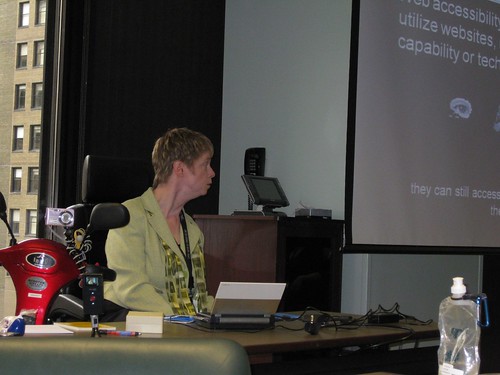
 Do you know how long I and millions of other people with disabilities have been dealing with less than accessible washrooms, curb cuts and such? Accessibility isn’t a new concept, yet many, many people still don’t get it until they are personally touched by the need.
 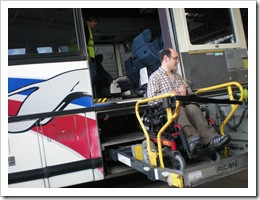 Early Wednesday morning found both Darrell and I boarding a Greyhound bus to Whistler Village. After much effort, we were both loaded and our chairs securely strapped into the bus. By batting my blue eyes and stating that I had done before, I was able to stay in my scooter on the bus; otherwise, I would have had to switch over to a bus seat and my scooter stored below, which I could have done, but sometimes its more the principle of it – not everyone can get out of their chairs.
 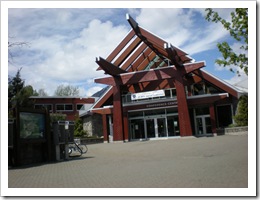 Two and a half hours later, along the Sea to Ski Highway that is still undergoing major reconstruction, we arrived safely in Whistler – a host city for the Olympic and Paralympic 2010 Winter Games.
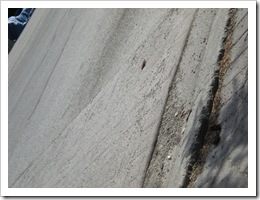 I understand that much work had been done to improve the accessibility of the village in preparation for the Paralympics. But, to be honest, I was less than impressed by what I saw. On the short walk from the bus loop to the Telus Conference Centre, the curb cuts were not well-defined and were in ill-repair. In the Conference Centre, I needed assistance to get around the tight corner into the washroom.
  Receive blog updates via
email
Receive blog updates via
email Subscribe via RSS


