Do It Myself Blog – Glenda Watson Hyatt

Motivational Speaker

7 Ways to Help Neighbours Shut in During Worst Canadian Winter in Years

Filed under: Living with a disability — by at 12:05 am on Sunday, January 4, 2009

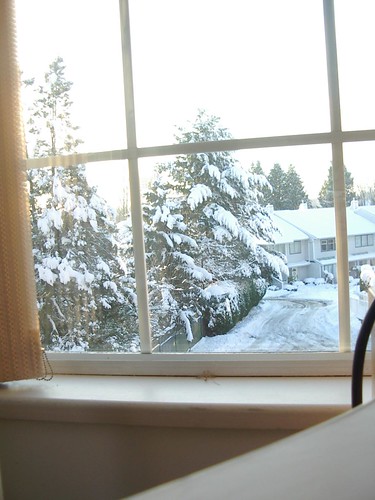
View from my home office window a few snow falls ago

Today marked Week Three of being cooped up inside during the worst Canadian winter in my lifetime. The decorative strips in the windows are feeling more like prison bars.

Thankfully Mom brought in a load of groceries last Sunday. We have plenty of food for a few more weeks. And, we do have neighbours we can call on should we need anything.

Others with disabilities, particularly with physical disabilities, and seniors may be more isolated, even if they live in the city. Meals on Wheels haven’t been able to deliver every day, leaving many seniors without hot meals. HandyDART doesn’t run in some areas when it snows. Sidewalks and curbcuts are impassable, further restricting people from being out and about in their community.

Even though the tinsel and garland have been put away, please extend the Christmas spirit by checking in on your neighbours, especially those living alone. Let them know you would be happy to:

  • shovel the driveway and walkways,
  • fetch the mail,
  • take out the garbage and recycling,
  • pick up groceries (and prescriptions or medical supplies),
  • run urgent errands, and
  • prepare a few meals.

Talking over a cup of tea or watching a movie together can make the long winter days less lonely and isolating.

If you enjoyed this post, consider buying me a chai tea latte. Thanks kindly.

Random Posts

The Gift is Within

Filed under: Living with a disability — by at 1:37 pm on Monday, December 15, 2008

One pleasure of being a blogger is receiving emails from readers. Although I don’t always respond, I do read each and every one. A month ago I received this heart-tugging email from Pamela, to which I have been pondering how to respond ever since:

Reader's Question

I was thrilled to come across your website tonight! I know you’re probably a busy woman, but I was wondering if I could ask you a question. I know a family with a beautiful 8 year old daughter who has severe spastic CP. Right now she’s really struggling with self confidence, realizing how beautiful she is, and with not being able to verbalize her thoughts. To make it worse, despite how very much she is loved, no one can truly understand what she is going through. I’m sure you get this kind of request often, but I was wondering what words of wisdom you could give us? I read Jana’s post of August 29/07 and the advice you gave her on parenting children with special needs. I was wondering what kind of encouraging words you would offer to M herself?

(My first thought: Damn cerebral palsy for making yet another precious child feel this way!)

Glenda's Response

Pamela, thank you for your touching email. I fully appreciate M’s frustration in her inability to voice her thoughts and needs, and no doubt her family’s frustration at not knowing what their daughter is thinking and wanting.

Finding a way for M to communicate effectively, no matter the method, is crucial for her life. I would suggest working with M’s current abilities and going from there. It may mean using a word board, developing a picture/symbol board, typing with her toe or whatever. It may not be something the professionals have considered or approve of. (They strongly discouraged me from typing with my left thumb back in Grade 1. Little did they know I was meant to become the Left Thumb Blogger!) Keep trying different things until something clicks. This will entail ample creativity, ingenuity and patience, with M leading the way.

Regarding boosting her self-confidence, be sure to praise and acknowledge her for her efforts, no matter the result. Keep photos of her in places of honour, alongside photos of her siblings, cousins and friends swinging the baseball bat or dancing at their first recital. And, of course, continue reminding her she is loved and valued.

With support and caring from you, her family, friends and teachers, M will reach her full potential and beyond!

Dear M,

You are a precious gift. Your outer body – the part everyone sees – is the wrapping paper – the part of the gift that is often put aside. The actual gift lies deep within you and is more precious, more beautiful than the wrapping paper.

Your eyes and your smile provide people with a peek at the gift within. Give the people you meet a big peek at your gift by flashing them a great big smile and showing them your beautiful eyes.

I understand how frustrating it is not being able to say what you are thinking and feeling. I have no doubt you have much going on in that beautiful head of yours. The challenge is to find a way to communicate it. There are more ways to communicate than by speaking. I’m sure with help from your family, teachers and therapists, you will find a way to communicate your thoughts. Keep trying and working hard and you will find a way for your voice to be heard.

You are a beautiful young lady, M. Wishing you every success.

With much love,
Glenda

Technorati Tags: ,

If you enjoyed this post, consider buying me a chai tea latte. Thanks kindly.

Random Posts

Spotlighting Businesses That Are Improving Accessibility for People with Disabilities

Filed under: Accessibility 100,Living with a disability — by at 10:43 pm on Tuesday, December 9, 2008

Accessibility 100Accessibility 100 provides easy-to-implement, free and inexpensive ways for improving accessibility for people with disabilities, dispelling the myth that accessibility needs to be expensive and difficult to achieve. Let’s spotlight Accessibility 100 in practice.

Oftentimes businesses and establishments make the news for not providing access for people with disabilities. Let’s turn that spotlight around and shine it on businesses and establishments that have improved access or service for people with disabilities in small yet meaningful ways, or even for one customer in that moment.

For example, several years ago Darrell and I spent our anniversary at Crescent Beach. We found a small place somewhere along the water for dinner. Once we had eaten, I had to use the washroom. The single washroom was tiny. There was no way I could get my scooter in and close the door. Of course, every restaurant should have a wheelchair accessible washroom; however, sometimes reality bites! In that moment, I had to use the washroom and I had no clue where the nearest accessible one was. The waitress kindly helped me to walk into the washroom, waited for me, and then helped me back to my scooter. That was not likely in her job description, but she did what she could to compensate for the building’s lack of accessibility. For that I am appreciative.

More recently, at the Sandman Inn in Castlegar, the manager ensured appropriate grab bars were installed in the otherwise fairly accessible bathroom before I returned to my room on the second night. This enabled me to safely use the toilet.

How many other individuals do what they can to make their businesses or establishments accessible, in that moment, for a customer/client/patron with a disability?

Let’s spotlight individuals and businesses that have taken small steps to improve accessibility, one customer at a time. To get this going, I am tagging Kara Swims, Lori-ann Engel, David Hingsburger, Norman Perrin, Nickie, and Karen Putz.

Haven’t been tagged? Not to worry. Either leave your story in a comment below or share your story on your blog and link back to this post. That way all of the stories will be gathered in one place for others to read and to learn from.

Let’s hear your (or a loved one’s) story!


Accessibility 100 is a series of 100 easy-to-implement, free and inexpensive tips for improving accessibility for people with disabilities. This is a community project. Feel free to leave your comments, questions and ideas for future Accessibility 100 posts.

Get the entire series by subscribing to this blog by filling in the form in the upper right corner or by subscribing to the RSS feed.

If you enjoyed this post, consider buying me a chai tea latte. Thanks kindly.

Random Posts

The Master in Applied Disability Studies Continues

Filed under: Living with a disability — by at 10:20 am on Friday, December 5, 2008

Two weeks ago I did an interview with Fernanda Araujo for her Masters in Applied Disability Studies. This week she had a few follow up questions.

1. Can you start by telling me something of what it is like to live with disability every day?

For the most part, having a disability isn’t something I really think about. I don’t wake up every morning and think, "Damn, I have cerebral palsy yet again!" I go about my day, doing what I do, the way in which I do it. At times I hit a bump or barrier and need to find how to work around it. But, really, I don’t know what it is like to live without a significant physical disability. Living with a disability daily is how life is and I deal with it, day by day.

2. What are some of the main challenges you face? What strategies do you use to meet such challenges?

My biggest challenge is verbal communication. Because of my speech impairment – I speak Glenda-ish – most people find it difficult to understand me, which severely limits who I can talk to. This is rather isolating at times. Through the years I have used various strategies to work around my speech:

  • An alphabet card to spell out words for people. During my university years, that card became my security blanket. I didn’t live my apartment without it.
  • Notes that I typed ahead of time. I dubbed them my talking papers.
  • Now I use text-to-speech software and the voice of Kate to give speeches and presentations.

I have found having a variety of strategies to be the key. That way I have a choice of which to use, depending upon the situation.

3. Do you ever feel marginalized? Disadvantaged?

I felt the most marginalized or disadvantaged was when I was searching for a job. Because of my disability, I can not answer phones or type at 60wpm – job requirements for many entry level positions. Employers seemed unable or unwilling to look beyond my cerebral palsy with its jerky movements and strained speech to see my abilities, skills and passions. Employers were unwilling to take a chance in hiring me. Being excluded from the labour force, after working as hard as my peers in school and university, I felt marginalized by society.

However, because I was excluded from the labour force in one sense, I have found other ways to put my abilities, skills and passions to use in rewarding ways. I imagine I am happier and more fulfilled doing what I am nowadays with blogging and such than I would have been in a 9 to 5 type job. I am confident that the income will come.

4. What have you learned from your disability? How has it made you a better person?

Without knowing the type of person I would have been had I not had a disability, I think my cerebral palsy has magnified my determination, persistence and creativity. Having a disability has taught me to be open and accepting of differences and to try to accommodate those differences. It has taught me to flexible and to find possible solutions. I am continually learning patience and understanding.

5. How do other people look at your disability?

This is a difficult question to answer because I rather not speak for other people. Some see my disability first; others see beyond my cerebral palsy to see me.

6. What about your close relationships with people? In what ways do they treat you differently and in what ways does disability make no difference to them?

My close friends and my family see beyond my disability and accept me for who I am. They willingly make allowances when needed and they know when I can do things myself (sometimes with a gentle reminder). They expect no less from me simply because I have a disability.

7. Are there other aspects of disability that are important to you?

Tightly intertwined with disability is the need for accessibility in every aspect of life: housing, education, transportation, shopping, employment, banking, websites, health services, recreation, entertainment, sidewalks… Every where. It is that accessibility that enables me to live my life as independently as possible. Accessibility enables me to say, "I’ll do it myself."

If you enjoyed this post, consider buying me a chai tea latte. Thanks kindly.
Random Posts

7 Wonders of the World of Disabilities

Filed under: Living with a disability — by at 11:48 pm on Thursday, November 27, 2008

In 2007, the New7Wonders Foundation revealed a new list of seven international representatives of historical human heritage, as determined by 100 million global citizens casting their votes. Intrigued and inspired, Exceptional Parent Magazine’s editorial staff what or who they would name to the 7 Wonders of the World of Disabilities. After spending the past year talking with leaders in the disabilities field, their list was featured in the November 2008 issue:

  • Landmark legislation the Americans with Disabilities Act (ADA) and the Individuals with Disabilities Education Act (IDEA) guarantees Americans with disabilities various rights under the law, including accessible housing, public buildings and a "free and public education’;
  • The communication breakthroughs of the creation of the Braille System and the use of Sign Language provide many with the ability to effectively communicate – a "paramount process in the human experience.
  • The Wheelchair provides the ability to be mobile and the feeling of freedom to those with physical disabilities.
  • The Special Olympics offer individuals with intellectual disabilities to develop self-esteem, strength and skills through competition.
  • Dr. Wolf Wolfensberger’s principles of Normalization and Social Role Valorization are part of the reason social services even exist today for people with disabilities. (These principles will take further reading on my part. I’ll share what happening learn in a future post.)
  • The U.S. Human Genome Project may "hold the answer to a multitude of questions about the many human genetic disorders that affect children and adults."
  • The medical breakthroughs of the Guthrie Test and the Polio Vaccine are "highly significant because of their historic qualities, their far-reaching impact, and the face that they represent discoveries that sought to prevent a disabling condition altogether or lessen its impact."
  • An honourable mention goes to Assistance Animals for their ability to assist and comfort individuals with disabilities.

The entire article is available on the New7Wonders website. Ironically, the article is presented as a series of images, making the text inaccessible to those using refreshable Braille displays, screen readers and other assistive technologies. (I merely shake my head. What else can I do?)

Special thanks to my friend Loree for bringing this article to my attention!

What do you think of this list? What would you add or change?

Technorati Tags:

If you enjoyed this post, consider buying me a chai tea latte. Thanks kindly.
Random Posts

« Previous PageNext Page »