Do It Myself Blog – Glenda Watson Hyatt

Motivational Speaker

What’s in My Networking Toolbox?

Filed under: Living with a disability,Work — by at 8:58 am on Tuesday, October 28, 2008

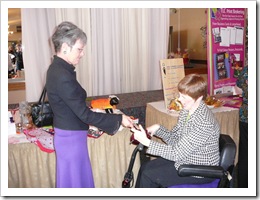
Debra and Glenda exchanging business cards

Last week I had the pleasure of being the guest speaker at the Surrey – Delta Chapter of the Valley Women’s Network. Networking is much more than exchanging the obligatory business card; although that is often the first step.  

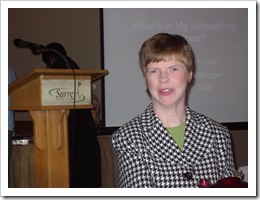
Glenda Watson Hyatt prior to presenting

As a business woman with a physical disability and a significant speech impairment, I have had to find ways to network that work for me. In my presentation, offered below as a 15-minute video, I share what is in my networking toolbox.

Special thanks go to S. R. Emerson of Accrete Web Solutions for the hook up and to Bimy Dobson for the chauffeur service to the luncheon. 😉

What’s in your networking toolbox? Which tools are effective for you? Are there any taking up valuable space that need to be discarded? Are there any tools you would like to try?

Technorati Tags: ,,,

If you enjoyed this post, consider buying me a chai tea latte. Thanks kindly.

Random Posts

Blog Action Day 2008 – Poverty from a Personal Perspective

Filed under: Living with a disability,Work — by at 11:16 pm on Wednesday, October 15, 2008

Blog Action Day 2008 - Poverty

Today is Blog Action Day 2008 – a day when bloggers from around the world join their voice to bring attention to a specific issue. This year’s issue is poverty. Living with a significant, lifetime physical disability, poverty is an issue with which I’m well-acquainted.

Here are a few sobering facts from the Council of Canadians with Disabilities

  • Persons with disabilities face levels of poverty almost twice that of persons without disabilities
  • Two-thirds of Canadian adults with disabilities lack one or more of the educational, workplace, aids, home modification or other supports they need
  • Almost 60% of working age adults with disabilities are currently unemployed or out of the labour market
  • For women with disabilities, almost 75% are unemployed/out of the labour market
  • According to the International Labour Organization, the annual loss of global GDP due to the exclusion of persons with disabilities from the labour market is between US$1.37 trillion and US$1.94 trillion (emphasis added)

I am one of the 75% of working age women with disabilities currently unemployed/underemployed; albeit, not by choice. I did have a part-time job for one year, shortly before I was married – a job I loved and was totally passionate about. I felt good and proud of myself to be of off social assistance, finally. But, it was a government-funded make work project and, at the end of the year, there was no more funding.

I did try to find another job and went few a few interviews, the ones I could physically get to. But then my significant speech impairment and typing speed were barriers. Many entry-level office jobs include answering the telephone and typing at a ridiculous speed. At that point, the value of the left thumb wasn’t appreciated.

Left with no viable choice, I decided to go the self-employment route. Not that I wanted to be without a regular paycheque, paid holidays, a pension plan and the other benefits that go along with a job, but, I figured, by working from home, I could accommodate my disability by not needing to deal with inaccessible buildings and I could work on a schedule that worked with my energy levels, as long as the work was done on time.

And, I have landed several interesting contracts through the years; oftentimes, the client was not aware of the extent of my cerebral palsy. My ability was measured by the worked I produced, not by how I produced it.

But, paying contracts were sporadic. So, when my husband was laid off due to the federally government’s decision to no longer fund computer training programs for people with disabilities – Darrell is a computer instructor, and a damn good one! – we ended up back on social assistance yet again.

Last week I received the Good and Services Tax Credit/BC Low Income Action Tax Credit Notice, along with fellow British Columbians. There in black and white is our 2007 family net income, which is well below the average income of working people with disabilities, ages 35 to 44, according to the Statistics Canada’s Participation and Activity Limitation Survey 2006 released yesterday. Our net income even falls below the Low Income Cut Off (also known as the poverty line) for communities with a population between 100,000-499,999.

That stings! After working off my butt in high school and then seven years at university, getting good grades, I never imagined being here at nearly age 42. And, when my able-bodied friends and colleagues make three or four times or more than I do, that hurts. I’d like to think I work as hard as they do, yet I am living below the poverty line. Why did I bother trying so hard all through school? What was the point?

But, I try to focus on the bright side. We eat two or three meals a day, which is much more than millions around the world eat. We have a beautiful home and, at the moment, we can afford the mortgage payment, making us more fortunate than many others. Our other basic needs and the occasional wants are met. We are in negligible credit card debt compared to others with four or five times the income. We could probably show the Suze Orman types a few ways to save money!

Recently we’ve been shopping at the Quest Food Exchange – a low-cost grocery store for those on social assistance. Quest saves over 480,830 pounds of non-marketable food (i.e. bent cans, dinged packages, slightly out-dated) every month from the landfills and redistributes it those in need. Initially, I was embarrassed to enter the store; after all, we aren’t that in need, leave the food for those who really need. Then I realized it wasn’t about swallowing pride; its about doing what is necessary to get by and, eventually, to get ahead.

I still believe it is possible to get off of social assistance, permanently, and to be on the other side of the poverty line. Until then, I am happy in life and feel blessed with all that I do have.

(I’d like to thank Jill Atkey at SPARC BC (Social Planning and Research Council of British Columbia) for finding these statistics for me today. Thanks, Jill!)

If you enjoyed this post, consider buying me a chai tea latte. Thanks kindly.

Random Posts

What Makes a Hotel Room Accessible?

Filed under: Accessibility 100,Living with a disability — by at 11:47 am on Thursday, October 9, 2008

Accessibility 100 This past weekend I traveled, in my capacity as Board Director and Treasurer, with SPARC BC (Social Planning and Research Council of British Columbia) to Castlegar, a small town located in southeastern BC. Following the lessons learned from our trip to Victoria a couple of years ago, where I could barely get into the bathroom of my accessible hotel room, the SPARC staff went trough an extensive accessibility checklist when booking the hotel for our group. SPARC was assured by hotel staff that the Sandman Inn was accessible and that the accessible room had the necessary features. Even when checking in on Friday evening, the front desk staff told us there was a grab bar by the toilet.

Because there were a few stairs up to room wing and the elevator, I had to outside and around to another door to get to my room. That wasn’t too bad in the rain, but would have been a real pain with a foot or more of snow! SPARC staff Alla and Emese went with me just in case…

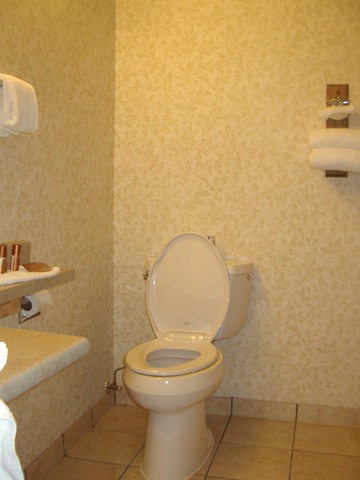
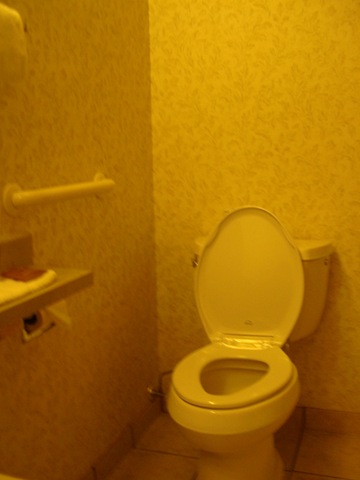
Toilet with no grab bar

Entering the room…Surprise! No grab bars, no where!

Alla and Emese went back to talk with the front desk lady, who was less than helpful. Then called the hotel manager at home and woke him up. After a brief discussion, he promised to have bars installed the next morning. Meanwhile, I was thankful Mom had taught me to "hang onto the air" when necessary. I managed to do what I had to. 

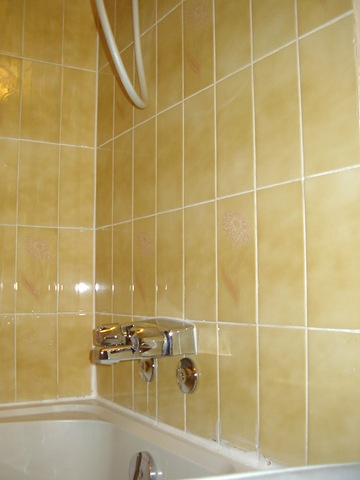
A shower with an unreachable shower head

Looking around the accessible room, I noticed more glaring accessibility issues. The shower head was hung at a standing level. There was no way I could have reached it. The taps were knobs, rather than levers, making it difficult, if not impossible, for those with minimal manual dexterity to turn on the water.

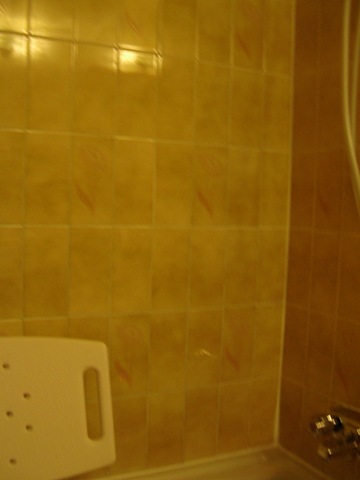
A bathtub with no grab bar

A shower bench was provided. Actually, initially, the bench was beside the toilet. According to the front desk lady, I was suppose to use that to help me get onto the toilet. Huh? I guess I’m not disabled enough to figure out how to do that. Alla placed the shower bench in the tub (go figure!), mainly to get it out of the way. With no grab bar in the shower and after my adventure in Vegas, I didn’t chance having a shower. (Shh, don’t tell anyone!)

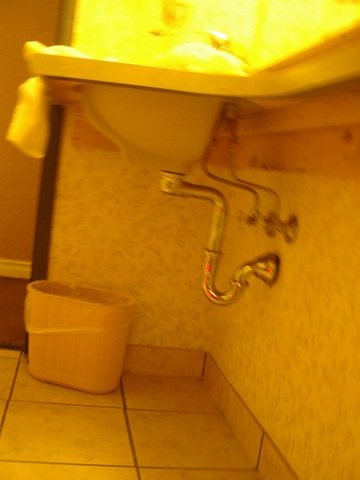
A roll-under sink with exposed pipes

The sink had plenty of clear space underneath for an individual in a wheelchair to roll under. The tap had a great lever handle. However, an individual with limited or no sensation in his/her legs can easily be burned by the pipes when running hot water. That is why exposed pipes must be wrapped in insulation.

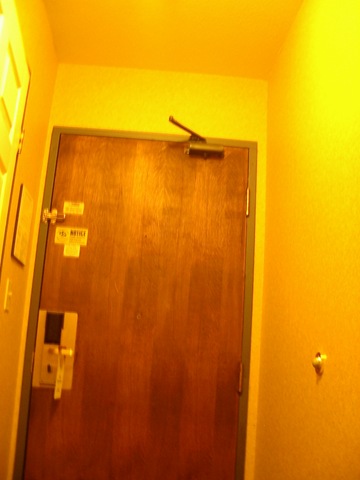
The door with a lever handle and a lower peep hole,  but a high door lock

Unlike the bathroom door that had a door knob, the room door had a nice lever handles – levers are much easier to open by individuals with limited hand function. There was even a second peep hole at seated level. (Personally, the lower peep hole has always baffled me. Looking through it, am I suppose to recognize people by their crotch?Anyway, a nice touch.)

But, do you see where the safety lock is? Yes, near the top of the door! I had to stand up to lock the door.

A toilet with a grab bar mounted on the wall

After some assertive advocating by SPARC staff, on my behalf, Room #124 at the Sandman Inn now has one grab bar! Which is a good thing, considering that was the only accessible washroom available during our day long board meeting, but that’s another story.

Thanks SPARC BC!


Accessibility 100 is a series of 100 easy-to-implement, free and inexpensive tips for improving accessibility for people with disabilities. This is a community project. Feel free to leave your comments, questions and ideas for future Accessibility 100 posts.

Get the entire series by subscribing to this blog by filling in the form in the upper right corner or by subscribing to the RSS feed.

If you enjoyed this post, consider buying me a chai tea latte. Thanks kindly.
Random Posts

Breast Cancer Awareness Month: What about the Boobs on Wheels?

Filed under: Living with a disability — by at 6:21 pm on Thursday, October 2, 2008

With October being Breast Cancer Awareness Month and with the age of 42 being around the corner (November 4th to be exact), screening mammograms are on my mind. I appreciate the importance of having early mammograms, but having one done terrifies me! Unlike many women with physical disabilities, I am able to stand for a few moments. However, I do falter at times. I can only imagine the excruciating pain if I should lose my balance while my breast is held firmly in the vice-grip.

No doubt there are mammogram machines accessible to women in wheelchairs, but I have yet to see a picture of one. And, how many local screening clinics have such machines? How accessible is breast care (and, sexual health care, for that matter) to women with disabilities?

Come to think about it, I don’t recall seeing a Breast Cancer Awareness campaign photo including women with obvious disabilities. Surely these campaigns are totally inclusive. Yes?

Tomorrow morning I am heading out of town for a weekend Board meeting, but I’d love to explore this issue further upon my return. So, if you have had experience, personal or professional, on this issue, or if you know of a relevant resource, feel free to leave a comment below. Depending upon your interest, this might be a great topic with which to reopen Readers’ Cafe. Yes?  

Have a great weekend!

If you enjoyed this post, consider buying me a chai tea latte. Thanks kindly.
Random Posts

Traveling with Autism

Filed under: Living with a disability — by at 3:09 pm on Tuesday, September 30, 2008

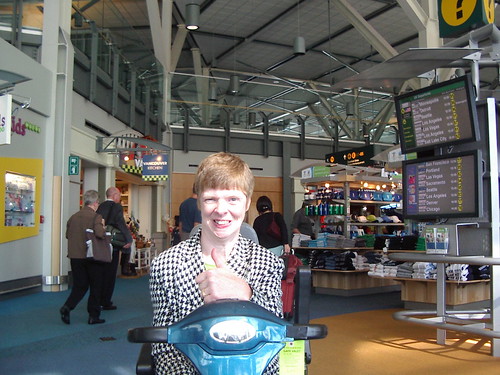
Glenda at Vancouver Airport, waiting to board plane to Las Vegas Having returned from Las Vegas last Monday and heading to Castlegar this Friday, traveling with a physical disability is possible, even though extra considerations are necessary. Airline staff and fellow travelers, for the most part, are understanding and willing to assist when required. God willing, I reach my destination.

However, for people with invisible disabilities, such as autism, the need for assistance and accommodation is not obvious. Even with all of the preparations in place, a trip may still need to be aborted at the last moment like Barbara Hines’ heart-wrenching story about trying to go on a well-deserved and much-needed family vacation. As Barbara shares in her story, fellow travelers can do much in assisting when traveling with an autistic child. An understanding smile can go a long way in easing the stress of a beleaguered parent facing a sea of judging eyes.

With the incidence of autism on the rise, more and more individuals with autism will be traveling. If you are a frequent traveler, these tips may assist you the next time a stressed out individual needs compassion. If you are a parent, these tips may assist you in preparing for a tip with your child with autism.

These tips are merely a starting point. Feel free to share your tips for traveling with a disability in a comment below.

Technorati Tags: ,,

If you enjoyed this post, consider buying me a chai tea latte. Thanks kindly.
Random Posts

« Previous PageNext Page »