Do It Myself Blog – Glenda Watson Hyatt

Motivational Speaker

Accessibility: A Personal Perspective
Filed under: Accessibility 100,Living with a disability — by at 3:06 pm on Friday, July 4, 2008

Accessibility 100

When talking about accessibility, it is easy to get caught up in the necessary width of doorways, the need for ramps built at a certain incline, and the height to install grab bars in wheelchair washrooms. And, of course, the cost of it all! But, what is often missing from the discussion is the why. Why go to the bother and cost of making places accessible? Why does it matter?

Please allow me to share my “why”:

On Tuesday, my husband and I, both wheelchair users, decided to go out to celebrate our nation’s birthday with fellow Canadians. Without a definite plan in mind, we took the Skytrain into Vancouver. When the elevators are working, the Skytrain is an easy mode of transportation for us. We merely wheel into a train car and then wheel off at our destination.
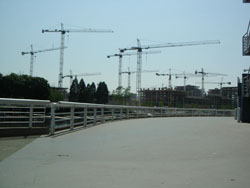
2010 Olympic Athletes Village under construction

Getting off at the Main Street/Science World Station, we first took in the progress of the Athletes’ Village for the 2010 Olympics. What an amazing sight seeing a dozen cranes in one location! All of them operating at once must be quite a dance.

Then we followed the path around False Creek, with the rest of the cyclists, inline skaters and walkies. This route is one of our favourite outings because it’s nicely paved and bricked, fairly flat and no car traffic to watch out for. We can go for miles without needing to contend with barriers.

View of False Creek

Some of the sights leave us puzzled though. We have no clue what this tripod structure is: a piece of abstract art, a marker of some kind or alien spaceship?

We stopped at Urban Fare for a bite and our first iced mocha. Those could be addictive!

At my age, I have learned not to pass by an accessible washroom without using it – there isn’t always one around when needed. Urban Fare’s accessible washroom was pretty good; definitely doable – and that is what counts!

From False Creek, we headed across downtown to Canada Place, grateful that there were sidewalk curbcuts on every corner. Where possible we avoided a few curbcuts that either were a little too steep or went out into of oncoming traffic.
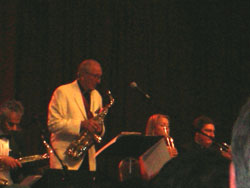
Dal Richards performing at Canada Day

Unknowingly we arrived at Canada Place in time to catch Vancouver legend Dal Richards and his band perform. Watching him took me back to the early days of the Variety Club Telethon where he conducted the orchestra for the entire twenty-two hours. Now at 90, I’m sure it is his passion for music that has kept him so young!
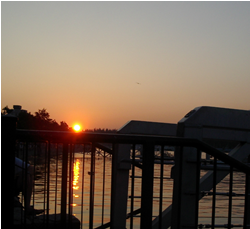
Sunset at Harbour Park

With the festivities at Canada Place over, we found our way down to Harbour Park to wait for the fireworks. Alternative sidewalks around construction sites were accessible. Long ramps at the park made it possible for us to get down the harbourside, which gave us a perfect vantage point.

Once again, I didn’t pass up the opportunity to use the public washroom, which was, again, quite accessible.

After putting several miles on our chairs, we took the Skytrain back home to Surrey.
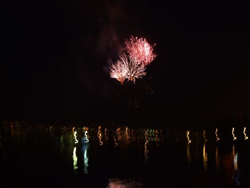
Canada Day 2008 Fireworks
(Photo credit: Darrell Hyatt)

I honestly do not know how much it cost to make that day accessible for us and other wheelchair users, for parents with baby strollers, for cyclists and for others on wheels. But, I do appreciate being able to get out in the community like that.

Being able to “ooh aah” fireworks with fellow Canadians: priceless!


Accessibility 100 is a series of 100 easy-to-implement, free and inexpensive tips for improving accessibility for people with disabilities. This is a community project. Feel free to leave your comments, questions and ideas for future Accessibility 100 posts.

Get the entire series by subscribing to this blog by filling in the form in the upper right corner or by subscribing to the RSS feed.

If you enjoyed this post, consider buying me a chai tea latte. Thanks kindly.
Related Posts

When Online Friends Meet In-person

Filed under: Blogging,Living with a disability — by at 4:16 pm on Thursday, June 19, 2008

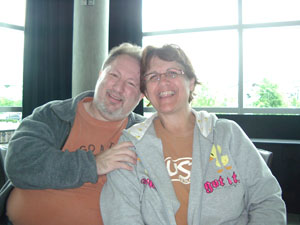
Todd and Sharon from St. Peters, Missouri

Last week I had the pleasure of meeting my Twitter buddy @tojosan, aka Todd Jordan, and his wife Sharon from St. Peters, Missouri. They were visiting family in the Seattle area and came across the border “to meet a few friends they had only met online”. (Nothing suspicious there!) It was Sharon’s first time to a foreign country. She was amazed to see so many American chain stores. (I’ll save that topic for another post.)

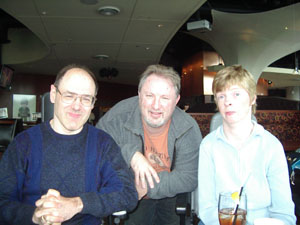
Darrell, Todd and Glenda

Meeting an invisible friend face-to-face to the first time always causes me a little apprehension. Will the real me live up to my online personae? Or will my cerebral palsy in person disappoint? But, I soon discovered I had nothing to fear with Todd who, in @conniereece’s words, “is a big ol’ teddy bear of a guy with a huge heart.” I totally agree! Having Darrell there to translate Glenda-ish definitely helped. Although, with more time, I’m sure both Todd and Sharon could master that foreign language!

Hanging out with friends, talking about blogging, social networking and such – what a great way to spend a nearly-summer afternoon (that’s why we’re all wearing sweaters!).

Reader's Question

Awhile ago, I told readers to go ahead, ask me anything. Now is a good time to answer Todd’s question, “How are you able to stay so busy with your extensive disability? Is it a matter of not accepting that you are significantly impaired? A high energy spirit? Your uplifting voice is just amazing.”

Glenda's Response

Thank you for your kind words.

I am often curious to know how people think I should being spending my days, living with my days. Spending my days watching television? Have you seen what is on tv right now? Boring! Or, sitting around, feeling sorry for myself? Double boring.

But, seriously, you ask a good question, Todd. Perhaps it is because of how I was raised: my parents did not allow my disability to be an excuse. They expected me to try and to do my best. Perhaps it’s focusing on the cans rather than on the can’ts. Or, perhaps its because I see opportunities all around and I want to experience as many as of them as I can squeeze in.

The bottom line is to focus on what I do have and what I can do, and to make the most of that and to be content with it. William Wordsworth’s sonnet Nuns Fret Not holds a special place in my heart (see pages 52-53 of I’ll Do It Myself for the full story):

Nuns fret not at their convent’s narrow room;
   And hermits are contented with their cells;
And students with their pensive citadels;
   Maids at the wheel, the weaver at his loom,
Sit blithe and happy; bees that soar for bloom,
   High as the highest Peak of Furness-fells,
Will murmer by the hour in foxglove bells;
   In truth, the prison, unto which we doom
Ourselves, no prison is; and hence for me,
   In sundry moods, ’twas pastime to be bound
Within the Sonnet’s scanty plot of ground;
   Pleased if some Souls (for such there needs must be)
Who have felt the weight of too much liberty,
   Should find brief solace there, as I have found.

~~ William Wordsworth, 1806

Sharon and Todd, thank you for crossing the border. It was so great meeting you both. I hope we can do that again next time you come north to visit your grandbabies. Todd, I’m looking forward to seeing you again at SOBCon in Chicago next May.

If you enjoyed this post, consider buying me a chai tea latte. Thanks kindly.

Related Posts

5 Ways to Increase the Accessibility of Blogs

Filed under: Accessibility 100,Blog Accessibility,Blogging,Living with a disability — by at 1:15 am on Thursday, June 5, 2008

Accessibility 100

Blogs create a way for people to share their thoughts, pass on information and connect with others from around the world. Blogs provide countless individuals with a door to the world. However, for many individuals, blogs slam shut that door by creating as much of a barrier as stairs do for wheelchair users in the brick-n-mortar world.

Within the confines of their blogging platform, there are ways bloggers can increase accessibility for people with some kinds of disabilities.

1. Provide ALT attributes for all images

Images present problems for people with sight impairments using screen readers – software that reads aloud what is displayed on the computer screen. This technology cannot read content presented in an image or graphic format. Also, individuals with older computers or slow Internet connections may surf with image loading turned off and will miss information presented visually.

The simple solution is providing text equivalents for all images and graphics. In HTML, this is the ALT attribute. The code for inserting an image would look like:

<…img src=”http://www.xxx.com/logo.jpg” alt=”Accessibility 100″ />

Individuals not able to see the image would hear or read “Accessibility 100”. They receive equivalent information.

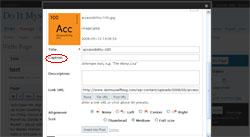
In WordPress (version 2.5.1), when using the “Add an image” feature, filling in the caption field provides the ALT attribute:


Screen shot of the “Add an image” dialogue box

Other blogging platforms will vary in how the ALT attribute is inserted. For bloggers comfortable with HTML, the platform may allow them to insert the attribute manually.

When writing ALT text, consider:

  • ALT text must communicate the purpose of a graphic accurately and succinctly.
  • the length of ALT in relation to image size (rule of thumb: 150 characters maximum),
  • if the image is purely eye candy, in which case the null ALT is appropriate. Without an ALT present, even a null one, an individual using a screen reader would hear “image”.

Not using images is not a solution. Images can increase comprehension and usability for others.

2. Make hypertext informative

Like sighted individuals, people using screen readers often scan a webpage for hypertext links that may interest them. Links like “click here” or “more” make no sense when read out of context.

To increase the accessibility of your blog, make hypertext links informative when read out of context, whether they are on their own or as part of a sequence of links. Make link text succinct.

For example, instead of:

Listen in on the interview here.

Try:

Listen to the interview.

Instead of:

…running two Group Research projects… (where each hyperlinked word points to a separate link)

Try:

…running the Internet Marketing Group Research Project and the Community Building Group Research Project

3. Maximize colour contrast

Screen shot demonstrating poor colour contrast

Blogs entails countless hours of reading. Enhance readability by maximizing contrast between text and background colours.

Consider these suggestions when choosing colour schemes:

  • Black on white is the most legible; white on black is reasonably legible; other colours on black are less legible.
  • Mixing yellow and black is fairly legible.
  • If using red or green text, make it large and bold enough to be legible in yellow.
  • Black on red and black on green are not legible, as some people will see them as black on black.
  • Combining blue and black is legible enough as long as it is not used for fine detail (e.g., paragraph text).
  • Combinations such as red-blue, green-yellow, green-white, green-gray are poor.

Colour blindness and the web will be discussed further in a future Accessibility 100 post.

4. Provide text transcripts

Audio and video add another dimension to blogs. These mediums benefit individuals with some kinds of disabilities, such as learning disabilities or cognitive impairments, who find reading long pieces of text difficult and laborious.

However, for individuals who are Deaf or hard of hearing and those who don’t understand the speaker’s accent (we all have accents!), this content is inaccessible to them. (Also, audio content is not yet searchable by search engines.)

The solution is to provide a transcript for all audio and captioning for video. Darrell Hyatt does an excellent job of providing transcripts for his podcasts. (Perhaps, in a future podcast, he’ll describe his process for using the voice recognition software Dragon Naturally Speaking for creating the transcripts.)

5. Avoid CAPTCHAs

Bloggers are inundated with spam comments. CAPTCHAs – Completely Automated Public Turing test to tell Computers and Humans Apart – are frequently used to weed out spambot comments from human comments.

a screen shot of a CAPTCHA

However, because CAPTCHAs are typically images of distorted characters, this information is not accessible to screen readers, leaving people who are blind unable to post a comment. As Darrell Shandrow, a screen reader user, said visual CAPTCHAs are “no blind people allowed” signs.

CAPTCHAs do not keep out only people who are blind. With the distortion of characters or extraneous markings, people with learning disabilities, particularly dyslexia, can have difficulty deciphering what the actual characters are. Likewise, with poor colour contrast, those individuals with colour blindness or low vision can also have difficulty getting past the CAPTCHA step.

One solution is to a combination of visual and audio CAPTCHAs. But, then people who are deaf-blind are excluded.

Avoid using CAPTCHAs, where possible, to moderate blog comments. Instead, use Askimet or other spam filters to control that unwanted spam. Make it as easy as possible to participate in your blog’s community.

Additional resources

For more information on web accessibility, check out these resources:


Accessibility 100 is a series of 100 easy-to-implement, free and inexpensive tips for improving accessibility for people with disabilities. This is a community project. Feel free to leave your comments, questions and ideas for future Accessibility 100 posts.

Get the entire series by subscribing to this blog by filling in the form in the upper right corner or by subscribing to the RSS feed.

If you enjoyed this post, consider buying me a chai tea latte. Thanks kindly.

Related Posts

Boy Voted Out of Kindergarten Because of Disability

Filed under: Advocacy,Living with a disability — by at 11:14 pm on Thursday, May 29, 2008

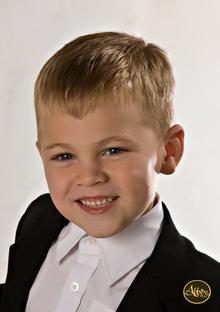
Alex Barton, a 5-year-old boy with blond hair and a big smile

Five-year-old Alex Barton was told to stand in front in his Kindergarten class while, one by one, his classmates said what they didn’t like about him – responding with such words as “annoying” and “frustrating”. Then, in a vote of 14 to 2, Alex was voted out of Kindergarten.

When his teacher Wendy Portillo, who implemented this punishment, asked Alex how he felt about what had occurred, he responded, “I’m sad.”

His crime: his “unusual behaviour” most likely caused by Asperger’s Syndrome, for which he is in the process of being diagnosed currently. Asperger’s Syndrome is often considered to be a type of “high functioning” autism, characterized by impaired social interaction and understanding, and restricted and repetitive activities and interests; learning and cognition are not usually delayed.

I was outraged when reading this story on Disaboom. How can an adult put a child through such hurtful humiliation?

The Florida State Attorney’s office concluded the matter did not meet criteria for emotional child abuse. No charges will be filed against the teacher.

Not emotional abuse?

Forcing a child to endure a verbal lynching is abusive, is emotionally and psychologically damaging!

A Thinking in Metaphors blog post details the teacher’s violations. Yet no charges have been laid?

Had Alex been an ethnic minority, there would have been protesting and rioting in the streets! But, because Alex has a disability, such conduct is okay? I think not! This is 2008, for pete’s sake! Society cannot turn away from such barbaric and cruel conduct, particularly from authority figures, any longer. This teacher needs to be held accountable for her actions and for the psychological pain and damaged she has caused.

Imagine how Alex feels about himself after being publicly humiliated by his peers. And, what about the other youngsters? How do they feel about tearing down a classmate? What has this taught them about accepting differences and bullying? Do they know the incident was wrong?

The children (and unenlightened adults) need appropriate education and guidance on accepting, valuing and embracing differences.

How can this adorable boy be anything but loved and cherished?

If you enjoyed this post, consider buying me a chai tea latte. Thanks kindly.

Random Posts

What Children with Cerebral Palsy Truly Need

Filed under: Living with a disability — by at 11:44 am on Tuesday, April 29, 2008

Reader's Question

A few weeks ago, Karen Putz asked this question, “For a child growing up with CP today, what are some things that we are still behind on doing for kids? What are some changes that could be made?”

Glenda's Response

Great question, Karen!

There have been so many advances in equipment and wheelchairs since I was a child. And, the relatively new field of assistive technologies has opened so many doors, particularly for children with more severe cerebral palsy. With technology, they can communicate, play music, use the computer, turn on lights and open doors, literally.

(With these advances, my cap has yet to come into being. A cap that would read thoughts and transfer them to the computer screen. Imagine how many minds, trapped within uncooperative bodies, that would unlock. One day, perhaps.)

In my opinion, what many of these children need is for the adults and decision-makers in their lives to look beyond the equipment catalogs and policy manuals and to develop solutions that work for the individual child. No two children with cerebral palsy are the same, so why are the solutions?

These children need to opportunity to reach their full potential, whatever that potential may be. As with any child, the early years are critical for maximizing development. But, when a young boy is seen only four times this year by the school district’s physical therapist – mainly to adjust his seating, not for actual therapy – because her caseload is overflowing and when the government refuses to pay for therapy outside of school unless it’s for post-op recovery, that is not acceptable. This child is not being given the opportunity to reach his full potential, unless his parents make further sacrifices to find alternative therapy for their son.

Another mother is left teaching her older son with severe cerebral palsy how to read because, last I heard, his special education teacher had not bothered to find a teaching method suitable for her child. For this particular teacher, his job was merely a paycheque. School for this child and his classmates is day care, rather than a stimulating learning environment. Their potential goes untapped.

A British father, frustrated by the lack of appropriate schooling opportunities for his daughter and worn down from fighting the system, banded together with other parents in similar situations to start their own school where their children learned and grew. Now, as their children reach adulthood and ready to transition to the next step in their life’s journey, the parents are left to battle the system to get services needed so these young people can continue growing. As the father said to me, a lot of energy is wasted in getting appropriate services, which detracts from family life and other commitments.

Imagine if these battles weren’t necessary and there was a cohesive and concentrated effort to provide children with cp with they truly needed to reach they full potential. Imagine what these kids could accomplish!

If you enjoyed this post, consider buying me a chai tea latte. Thanks kindly.
Random Posts

« Previous PageNext Page »