Do It Myself Blog – Glenda Watson Hyatt

Motivational Speaker

Medical Professionals Are the Worst Disablism Perpetuators

Filed under: Advocacy,Living with a disability — by at 12:18 am on Sunday, May 6, 2007

Despite taking an oath “to do no harm”, medical professionals are the worst at perpetuating disablism. Many of them do not see beyond the disability, disease or disorder to see the individual filled capabilities, potential and dreams. They use language that focuses on the deficit rather than on the positive. And, once an individual is diagnosed with a disability, then every future ailment is presumed related to that disability and is often discounted or completely disregarded.

I would like to share my most recent experience with medical professionals. For a bit of background: many, many moons ago, I had a triple arthrodesis done on both feet – surgery that, essentially, rearranged bones in my feet to stabilize my ankles, which were beginning to go over on their sides when I stood up. Despite the months of pain, the surgery was a success. I graduated from the heavy, metal long-legged braces to ones below the knee and then to none. However, the pediatric orthopedic surgeon warned that the bones may slip at some point in the future.

Fast forward to six years ago: bones in my left foot felt like they were grinding on each other, and the two protruding bones seemed to be protruding slightly more. When I showed my family doctor, his comment, in a patronizing tone, was, “Our bones tend to protrude as we get older,” at which point I was very tempted to have an intentional involuntary movement with my foot making forceful contact with one of his sensitive body parts. I was sent for x-rays, which, with athetoid cerebral palsy and constant movement, is another story.

Over the years I have shown my permanently swollen ankle to various doctors with little concern in return. One doctor did send me for more x-ray – another exercise in frustration. The radiologist report came back saying something like, “Paraplegic patient has no broken bones.” Up until this point, I had been a quadriplegic, meaning that all four limbs had been affected. Wow, a paraplegic! I had been half cured and hadn’t even realized it.

August, 2005, I was in for my annual thrill and asked the gynecologist for a referral to an orthropod. Her nurse chose a name from the yellow pages, further diminishing my confidence in the healthcare system.

After another fourteen months of pain, I finally had an appointment with an orthopedic surgeon, not that those are comforting words to me. Finally someone took interest in my foot. With more x-rays, it was determined that bones have not moved. Without comparing these x-rays with the post-surgery x-rays from years ago, I’m not sure how this determination can be made, but I’m not the highly educated, highly paid expert. The news that I don’t need surgery was a relief; I was dreading having to go through that painful experience again. He referred me to a brace maker; another idea that didn’t thrill me, but definitely better than undergoing the scalpel again.

November 3rd, 2006 – a day I remember well, although not fondly. We were caught in one of Vancouver’s worst ever downpours and Darrell’s electric wheelchair shorted out. We were soaked! The alleged brace maker turned out to be Rehabilitation Specialist of some sort. I have a semantic issue with rehabilitation and cerebral palsy. According to the Merriam-Webster Online Dictionary, to rehabilitate means “to restore to a former capacity”. Cerebral palsy occurs during or shortly after birth. There is no former capacity to restore.

Putting labels aside, this doctor proceeds to ask us a ton of questions unrelated to my foot, and adds, “I’ll ask you (indicating me) the questions, but I want your husband to answer to save time.” And this specialist is supposed to work with individuals to regain independence and self-reliance? It is interesting how medical professionals can least understand Glenda-ish. Any correlation with the amount of time they spend listening to their patients?

Almost as afterthought, he examined my foot. I was cold and wet, and he told me to just relax. Does this specialist know anything about athetoid cerebral palsy? A relaxed state is not something I can turn on and off on command. He concurred that I need a brace of some sort and referred me to an orthotist.

After a ten-minute appointment, Darrell and I left St. Paul’s Hospital and headed back into the downpour, at which point Darrell’s three-month-old wheelchair completely and totally died. We needed to get from downtown Vancouver to our home in Surrey. Darrell desperately called his friend who works at the University of British Columbia. Thanks to his friend pushing Darrell in his heavy chair to the Skytrain and then up the hill, we eventually made it home.

Friday, after a couple of canceled appointments due to bad winter weather, I had the first appointment with the orthotist, the brace maker. The appointment was off to the typical start of taking a history and ascertaining why I was there, but I had hope for her because she was listening to and, for the most part, understanding Glenda-ish. Then the Rehabilitation Specialist arrived late and the staff stood around discussing an upcoming conference and other clients – on my appointment time! I heard him mentioned he didn’t have my file because his secretary was on holidays, the replacement secretary couldn’t find the file or the dictation file on the computer. Considering she called me “Hyatt” when she phoned with the appointment time, my haunch is my name got messed up on the file, which subsequently was misfiled – another insignificant medical error.

Practicing some patience, they eventually rejoined Darrell and me in the exam room: two orthotists the rehab specialist, a physiotherapist, and a student, of course. They took turns poking and twisting my foot. Then they began discussing me as if I wasn’t there. I tried interjecting, particularly when the word botox came up. I said I would need a lot more information first, to which the specialist annoyingly replied, “Of course. We’re only strategizing.” Strategizing about me without me? I told Darrell that I’d rather have a rum and coke than botox to relax me for the casting. Unfortunately that didn’t get translated.

Not one of the four professionals explained the problem with my foot, what these braces or AFOs (ankle-foot orthotics) are like nowadays, or asked for my input. Some things haven’t changed in forty years, although I didn’t need to strip down to my underwear this time. I left with a sore foot and leg, and feeling less than an intelligent, independent and capable woman. In a way, I had been stripped. Would I have been treated the same way had I been an articulate able-bodied individual?

From what I understood from the discussion going on around me, a partial correction is probably the best that can be hoped for. My question is: if it hadn’t taken six years to get to this point, might the outlook be better? If I had been taken seriously by my family doctor back then, before my foot became worst, would a complete correction have been possible? Would this process have been quicker if I didn’t have cerebral palsy? Would I have been taken more seriously had I been a star athlete or a highly paid executive? How many doctors do I need to see in order to be heard?

These medical professionals can take a few lessons from the United Kingdom’s Good Medical Practice (2006), which “sets out the principles and values on which good practice is founded.” The duties of a doctor include:

  • Treating patients as individuals and respecting their dignity and right to confidentiality;
  • Working in partnership with patients by listening to them and responding to their concerns and preferences, and giving patients the information they want or need in a way they can understand; and
  • Respecting patients’ right to reach decisions with you about their treatment and care.

It would be so refreshing to have all doctors treat me in this manner. Is that too much to expect?

If you enjoyed this post, consider buying me a chai tea latte. Thanks kindly.

Random Posts

Social Assistance System Contributes to Disablism

Filed under: Advocacy,Living with a disability — by at 8:08 pm on Tuesday, May 1, 2007

Blogging Against Disablism Day, May 1st 2007

Since it is still May 1st, I am going take a second stab at writing a “Bloggers Against Disablism Day” (BADD) post. I don’t feel my first attempt was well thought out or well-written; in my mind, it was just…well…bad. The problem was I wasn’t really fired up about anything in particular. But, now I am, and when this red-head gets fired up about something, look out!

My husband Darrell also has cerebral palsy. He uses a manual wheelchair inside and an electric chair outside. Last year he went jumped through the hoops of getting a doctor’s letter and an occupational therapist’s (OT) assessment in order to get a new power chair through social assistance. The process took months and the thing cost as much as a small car!

Now he needs a new cushion for his manual chair. The gel has hardened, which isn’t comfy for his boney butt. Last week his family physician gave him a prescription for a gel cushion; he wrote what Darrell asked him to. After all, what does a general practitioner know about wheelchairs and cushions! Today Darrell took the script into the social assistance office to ask how to proceed; hoping that the current script and the documentation required for his eight-month-old power chair would suffice. Nope!

Darrell, who knows his own needs best, is not qualified to say what he needs. Rather, he needs to get a referral from his doctor (an appointment to get into see him takes a couple of week) to see an OT, which can another several weeks or months, to be assessed for the exact same cushion he has on his power chair and that is working for him. Then wait months for the approval process. Meanwhile, his ass hurts and we’re hoping he doesn’t end up with a pressure sore.

How is this assistance?

It’s not that we want to rely on social assistance; we’d much rather be financially independent. But, as I explained in my first BADD post, finding employment with a disability is not always easy. And, being “medical equipment”, the cushion is so outrageously priced; we can’t afford to buy it ourselves without a job. One cushion is the same price as our dining room table and six chairs (seat AND back!) we bought when Darrell was working.

This is only one example of how the system keeps us down and dependent. From personal experience, it is extremely difficult to free yourself once you are sucked in.

The decisions and policies that dictate our lives are made policymakers who have no clue about our lives. Yet, if we speak out, we are labeled as “bitter, ungrateful disabled people”.

Right now there is a lot of talk about Web 2.0, Accessibility 2.0, and this or that 2.0. I want to coin a new phrase “Disability 2.0 – Nothing about us without us”. Will it catch on?

May 7th update: This morning Darrell called the OT who assessed him for his power to ask about a new gel cushion for his manual chair. According to the OT, the Ministry pays for only one gel cushion because an individual can sit in only one chair at a time. To clarify he understood, Darrell asked, “So, am I suppose to levitate in mid-air as I swap my cushion?” Apparently the OT was annoyed with the question, said he didn’t have put up with such nonsense and threatened to hang up.

Because the OT has closed Darrell’s file, Darrell needs to go back through Central Booking for an appointment with this OT, which may take three weeks. Then the paperwork goes to Victoria for approval. If denied, since he already has one gel cushion, Darrell has the right to appeal, which takes more time – we’ve been there before. Meanwhile, Darrell is at risk of developing a pressure sore.

If you enjoyed this post, consider buying me a chai tea latte. Thanks kindly.

Random Posts

Blogging For Inclusion

Filed under: Advocacy,Living with a disability,Work — by at 2:24 am on Tuesday, May 1, 2007

Blogging Against Disablism Day, May 1st 2007

Today I join more than 100 other bloggers in blogging against disablism. The intent is, by joining together in discussing discrimination still facing people with disabilities, we will bring the issue to the forefront yet again.

What is disablism? A pamphlet by Demos, the British think tank for everyday democracy, offers this definition:

Disablism n. discriminatory, oppressive or abusive behaviour arising from the belief that disabled people are inferior to others.

(although you won’t find a definition in a dictionary)

Disablism is the British equivalent of the American term ableism used to describe discrimination against people with disabilities in favour of people who are not disabled. Ableism discriminates, devalues and denigrates the same as does racism and sexism. Ableism treats those without disabilities as the standard of “normal’, against which everyone is measured.

Being a woman who has lived with cerebral palsy for forty years, I could share countless stories about how I have been discriminated against and treated “less than” by doctors, bus drivers, potential employers, and strangers. Discrimination, whether direct or indirect, is the main reason I chose the self-employment route. It’s not because I didn’t want the steady paycheque, the pension plan, or the friendly banter around the water cooler; it is because employers couldn’t get beyond their heebee-geebees about my disability during the interview process.

One interview was at an inaccessible building (another form of discrimination), yet the employer blatantly refused to meet with me at a more accessible location. If he had determined I was the most suitable candidate and had offered me the job, Vocational Rehabilitation Services could have then stepped to assist in making the workplace accessible. By refusing to interview me, he did not permit me the opportunity to demonstrate my capabilities, skills and talents. I eased my hurt by convincing myself that he missed out on hiring the most meticulous and creative Newsletter Coordinator he ever would have had. But, in reality, the experience did (and still does) sting.

I could go on and on about ways I have experienced discrimination and disablism (or ableism, depending upon which side of the pond you are on); but, really, where would that get us? What good is rehashing negative experiences? And, according to the Law of Attraction, focusing on negativity will only bring more – that is something I can definitely do without! Rather than being against disablism, I’d rather be for inclusion. By focusing on what I want, rather than what I don’t, the Law of Attraction works in my favour.

Being self-employed and working mainly in the virtual world, I can choose when and how much to disclose to clients. Many clients do not know the extent of my cerebral palsy; those who do know do not see it as a factor as long as I can do the work. We focus on the task at hand and my talents, expertise and passions are fully utilized; such a liberating feeling!

If my disability doesn’t matter much online, how can we make disabilities less of a deal when face-to-face? How can we achieve an inclusive society? I’d love to hear your ideas. Let’s talk.

If you enjoyed this post, consider buying me a chai tea latte. Thanks kindly.

Random Posts

The Early Years, The Therapy Years

Filed under: I'll Do It Myself: The Book,Living with a disability — by at 9:18 pm on Monday, April 23, 2007

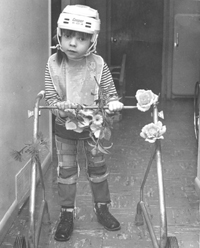
A young Glenda wearing long legged braces, standing with her walker.

I can now say I’m an internationally published writer! Reprint, with permission, from: OT Insight Vol. 28 No. 3 April 2007. Magazine of the New Zealand Association of Occupational Therapists (Inc).

Reflections – before you begin:

In this issue we are privileged to share an excerpt from the autobiographical writings of Glenda Watson Hyatt. We encourage all occupational therapists who read this article to use Glenda’s “lived experiences” to critically reflect on client-centred practice and the nature of occupational practice as we know it now, and in relation to that of yesteryear. Glenda provides us with a frank and open account of “what it was like” through the eyes of a young consumer of occupational therapy.

Many of you will identify with this piece of writing. Some may feel a little defensive, as our profession is not necessarily shown in a great light! After all, it does seem that the OTs were trying, but just didn’t get it right for Glenda. However you feel when reading this, hopefully you will use it for the opportunity that it brings to really listen to our clients’ stories, and to learn from their lived experiences. Such gifts as this help us to think about what therapy looks like to the recipient. Let us use our ability to reason interactively and conditionally. Let us focus on the person, not the component part of a task. Let us include the client in the reasoning process. Glenda’s experiences occurred some time ago – hopefully as a profession and as individual practitioners, we have moved on!

For further provocative reading, you might also like to visit the following website: http://www.disabilityisnatural.com

I entered this world one Friday morning in early November, 1966, in Vancouver, British Columbia. A light dusting of snow covered the ground. Mom said the North Shore Mountains looked like upside down pink ice cream cones as the sun rose outside her hospital room window.

Mom had a normal pregnancy, and everything was fine up until my actual arrival. Then the situation became somewhat scary and uncertain. Mom had a reaction to the Xylocaine epidural and went into convulsions. The doctor had to pull me out with forceps, which meant I didn’t have time to read the instructions on my way down the chute. I missed the fine print on needing to breathe immediately.

One doctor worked on reviving Mom, while another one worked on saving me. Luckily, a pediatrician specialist was just leaving the hospital and was called back to try to get me breathing. Perhaps it wasn’t a coincidence that the specialist was there at that particular moment. He was probably one of the angels sent to save me that day. It was touch and go for a while. Dad nearly lost both of us.

I definitely would not have held my breath for six minutes had I known what hassles it would cause for the rest of my life. Talk about learning from experience. You would think the first lesson for a newborn would be somewhat easier!

I was blue for a good part of my first day and was placed in the “no touch zone” as the intensive care nursery was called in those days. Only the doctors and nurses were allowed to touch me. Mom could only stand at the window and watch me. Apparently she would not go back to her room until she saw me move. She prayed hard that day that I would live. Live I did!

It was quite some time before I was officially diagnosed with cerebral palsy, or more accurately, cerebral palsy athetoid quadriplegia. The lack of oxygen had caused permanent brain damage, resulting in a lack of muscle control and coordination. My physical movements are jerky and involuntary; one body part or another is in constant motion. My left hand has some function, while my right hand is generally in a tightly clenched fist. I can’t walk without support, and my speech is difficult to understand. Finally, my head control is tenuous, and swallowing takes a conscious effort.

At six months of age, one doctor offered the opinion that I was mentally retarded and that I should be institutionalized. That would have meant a life with little or no contact with my family or the outside world. I would have received minimal education, living a life without hope or opportunity. Thankfully, my parents had their own unflattering opinion of that medical professional and did not follow his bleak recommendation.

At the age of two and one-half years, I started my school career at the Yellow Submarine, a special needs preschool at the University of British Columbia. One day, the psychologist, Dr. Kendall, came by to test if anything was going on in my damaged brain.

At that point in my life, my speech was very limited, consisting primarily of initial consonants and sounds. Going through the Peabody Vocabulary Picture Test, I uttered one response that he could not understand. Finally, in complete desperation, he called in Mom, who was observing from behind the magic mirror (actually a one-way window), to decipher what I was saying. Roo roo. The two of them gazed at the picture of a chicken. Roo roo. Suddenly it dawned on Mom. She asked, “Glenda, do you mean rooster?” Yes! The picture was obviously a rooster as it had a big, red comb. The experts expected me to offer the accepted response – chicken. Who was called mentally retarded?

Dr. Kendall reported that I was bright and showed potential. After all, I knew the difference between a chicken and a rooster before the age of three. Even with this encouraging report from the psychologist, I would be required to prove my capabilities and potential countless times throughout my life as so many people don’t see beyond the cerebral palsy to see me.

Following the only advice given by the doctor after my birth, my parents did take me home and love me. In the late 1960s, support was non-existent for parents who had children with special needs. My parents were left to figure out things on their own; they did the best they knew how at the time. Who could ask for more?

Mom was still completing her degree in education, with a specialty in Special Education – lucky me! Thus she had access to the medical library at the University of British Columbia, where she spent time reading about cerebral palsy and searching for answers to questions that could not yet be answered by the doctors.

Much of the time my parents muddled along, trying different approaches until they found one that worked. In the early years, feeding was definitely a major issue. Placed in the plastic cuddle seat on the table, I had a short attention span when it came to eating pabulum and other mushy baby food. I was either more interested in what was happening around me, or I was bored because it took so long to finish a meal. Dad learned to keep my attention while feeding me by sticking my favourite rattle, which had a suction cup, on his forehead. I doubt that idea was in a Special Ed textbook but rather an idea attempted out of sheer desperation!

Next was the high chair with a towel tied around my middle to hold me up. One time when Dad was feeding me, I picked up the spoon and threw it on the floor. Dad firmly said “No”, picked it up and placed it back on the tray. I did it again. Dad repeated his stern no. I did it again and, perhaps, again. Dad lightly smacked my hand. I cried. Dad went into his bedroom and cried. The incident taught both Daddy and his little girl that having cerebral palsy did not preclude me from discipline. That may have been the first incident of discipline, but it was definitely not the last!

As I grew and gained some hand control to do more than throw the spoon on the floor, I was able to feed myself, more or less. It was a slow process. I was nearly always left sitting alone at the table as I finished my supper. Some nights I exerted more energy than I gained by eating. It’s no wonder I was so skinny. The process wasn’t pretty, especially when I was tired, causing my involuntary movements to be even less controllable. Those mealtimes often resulted in a battle and tears at the dinner table. Perhaps this is why I’m still uncomfortable eating around others not close to me and try almost anything to avoid it.

When I graduated from my crib to my first bed, the bed was actually a mattress on the floor. At that time I was getting around by crawling on my hands and knees. By having my bed directly on the floor, I was able to crawl in and out of bed myself. Independence was important, even at a young age.

When we moved into a larger townhouse, I had my own bedroom with space for an actual bed. I was given the one Mom had as a child. To ensure the bed was still low enough for me to climb into by myself, Dad cut a sheet of plywood to lay across the bedrails, with the foam mattress on top. Who needs a box spring!

Beginning around the time of the Yellow Submarine and lasting for roughly a decade, I had therapy – physio, occupational and speech – several times each week. This was necessary to improve balance, muscle coordination and verbal communication. While therapy was necessary, it was seldom fun; like taking foul-tasting medicine.

Physio and occupational therapy involved monotonous tasks, such as repeatedly grasping beanbags and putting them in muffin tins, climbing up a few stairs to simply reach a brick wall, and being rolled around on a large, inflated ball or tube. This was all done stripped to my underwear. When I became older, I was permitted to wear shorts and a top.

In most cases, my therapists were not the brightest individuals. One day I came home from Kindergarten, nearly in tears. Mommy, my knees hurt. She sat me down and looked at my long-legged braces. The occupational therapist (OT) had put them on the wrong legs! Wearing shoes on the wrong feet causes some discomfort, but wearing heavy, metal braces on the wrong legs hurts. No doubt, I knew he was putting the wrong brace on the wrong leg. However, being nonverbal, I likely kept quiet, something I often did, because I thought he wouldn’t understand what I was saying, and I didn’t want to create a big hassle as he tried to decipher what I was telling him. After all, only people close to me understood Glenda-ish.

Feeding myself was always a struggle. The OT suggested that bending a spoon ninety degrees may make it easier for me to get the spoon into my mouth, a great idea. The next week, I took the spoon in my left hand, my only somewhat functional hand, and was all set to . . . feed the OT. He had bent the spoon the wrong way! Thankfully, it was not one of Mom’s good spoons.

In a similar attempt, he thought a swivel spoon might do the trick. This spoon had a large, plastic handle to grip and a spoon bowl turned ninety degrees, in the correct direction, which actually swiveled. Well, between my jerky, uncoordinated movements and this spoon swinging back and forth, the peas ended up across the room! I continued using a plain, unaltered spoon.

School was an older building; actually, it consisted of two buildings and a portable. The main building had four or five classrooms for the primary grades, the staff room, changing room and the principal’s office. The older kids were upstairs in the other building, accessible by a long, steep ramp.

As this was before integration and mainstreaming had been invented, all the Special Ed students went to this school, which was actually an annex of a larger school, several blocks away. This was definitely segregation. But, at that age, I didn’t know any differently. I was excited to be starting school with my new notebooks, crayons and lefty scissors. And, I do remember hating missing school when I was sick. It was so boring to stay home.

Being non-verbal, my teacher Mrs. Rutherford was concerned that she wouldn’t hear me when I needed help, so she gave me two small brass bells – I think they were her mom’s dinner bells – to ring to get her attention. It was soon discovered that the bells weren’t necessary as I was verbal enough to catch her attention when needed.

Because getting to the chalkboard was difficult for most of us once we were placed in our seats, we each had an 18-inch square piece of chalkboard at our desks for practicing our printing. It was also easier to work on a horizontal surface rather than a vertical one. Initially, my printing was wobbly scribbles. With practice and extreme concentration, I controlled my jerky movements enough to make my letters almost legible more of the time. I also kept a chalk eraser handy, though inadvertently an uncontrollable movement erased a good letter. In frustration, I did the letter again.

Although learning to print, and then to write, were important steps in learning to read, it was evident that printing would not be efficient. It took too much energy and was too time-consuming to keep up with my work, and that would only worsen through the grades. Learning to use a typewriter was a necessity.

An electric Smith Corona typewriter was placed at the back of the room, which a few of us shared. When it was time to do typewriter work, Mrs. Rutherford dragged me in my desk chair over to the typewriter table and then dragged me back to my desk when I was done. Then it was the next student’s turn. A while later, perhaps once funding became available, we each had a typewriter at a second desk beside us. We simply dragged the typewriter back and forth as we needed it. It was much easier, especially on Mrs. Rutherford’s back.

As I have only one somewhat functioning hand, I only typed with one hand, my left hand. While typing, I steadied my hand on the typewriter hood to give myself some control over the spastic movements and used my thumb to hit the keys, causing my wrist to be in a dropped-wrist position. This concerned the adults, particularly the physio and OT. Although this was decades before repetitive strain injury and carpal tunnel syndrome had been invented, they were concerned that the dropped-wrist position would cause damage over the long-term.

They decided a splint with a stick to hit the keys was needed to keep my wrist in a good position. With this contraption snuggly Velcro strapped to my arm, I was expected to have enough arm control to steady my hand mid-air, without resting it on anything, and to accurately hit the keys. And this was less frustrating than printing with a pencil? After a few days, the splint ended up in the back of my desk drawer, and I resumed typing with my left thumb, my hand in its compromising position. I type the same way today, as nothing else feels as natural. For a non-verbal individual who relies on written communication, my left thumb is my most valued body part.

My parents bought a Smith Corona typewriter for me to use at home. The OT suggested that a keyguard may prevent me from hitting multiple keys at once, and he offered to make it himself. Super. Months later he finished drilling the holes in a piece of Plexiglas. When installing the handmade keyguard onto the typewriter, it was discovered that there were more holes than keys! Another OT solution was tossed on the junk heap. Luckily, Smith Corona also made keyguards.

When I was ten or eleven, I had one OT who had me actually make things. She took me into the workshop and allowed me to use some of the tools. That was cool! I remember making a wooden doll bed. I even painted it, too. Then one day she told Mom, “Glenda figures out how to do things on her own, in her own way. She doesn’t need me. We are wasting her time here.” I finally had a therapist who made sense and actually understood me, and I had to let her go.

Physio and speech therapy also ended around the same time. I was at the age when I knew what I had to do in order to maintain the capabilities that I did have. Although the years of therapy are not among my fondest memories, I do realize it was necessary to maximize the mobility and functioning that I did have, and, for that, I am grateful.

Excerpted and condensed from Glenda’s recently released autobiography ‘I’ll Do It Myself’, in which she intimately shares her life story to show others cerebral palsy is not a death sentence, but rather a life sentence. Copies can be ordered from www.doitmyselfblog.com.

Glenda Watson Hyatt
Glenda@BooksbyGlenda.com

If you enjoyed this post, consider buying me a chai tea latte. Thanks kindly.
Random Posts

Constantly Finding Life’s Balance Point

Filed under: Living with a disability,Motivation — by at 2:03 pm on Friday, April 13, 2007

 A balanced stack of stones on a beach
(Photo credit: Anatoli Styf)

Since wrapping up my “40 Blogs in 40 (Business) Days” virtual book tour for my autobiography I’ll Do It Myself, I have been down with bronchitis. This bout has really sucked the energy out of me. With my cerebral palsy, nearly everything I do takes extra conscious effort, which tends to limit the energy I do have. This limited energy combined with the power surge from the bronchitis has left me doing the bare minimum for the past few weeks.

I find this “dead battery” feeling extremely frustrating because, even though I physically feel like doing nothing, my mind is still racing with ideas, plans and all the things I have to do. I then remind myself that, like everyone else, I am a not a human doing, but rather a human being. It is okay to sit mindlessly at my window and watch the birds build their nest; it’s okay to spend a couple of hours during the work day reading in bed – I may even finish reading April’s O Magazine before May’s issue arrives! Except for meals and minimal laundry, pretty much everything else really can wait.

Surely my book tour hosts won’t mind receiving their thank you notes later rather than sooner. The ebook about the lessons I learned from doing a virtual book tour can wait another month or so to be written. Revenue Canada, on the other hand, won’t really wait beyond the end of April for income taxes, so that becomes my top priority. What a priority! Other things, like drumming up votes for the Best of Blog Award, fall off the priority list. Although winning the award would be nice and would give Darrell and I a reason/excuse for going to Las Vegas, something we’ve been talking about doing for a few years, the award won’t change how I blog, and I doubt it would change my life’s larger picture.

Life involves constantly readjusting priorities and finding balance.

If you enjoyed this post, consider buying me a chai tea latte. Thanks kindly.

Random Posts

« Previous PageNext Page »