
Do It Myself Blog – Glenda Watson Hyatt

Motivational Speaker

Catching the Back to School Fever: Launching a Mini Series on My Years from Special Ed Class to University
Filed under: I'll Do It Myself: The Book,Living with a disability — by at 11:28 am on Thursday, September 10, 2009

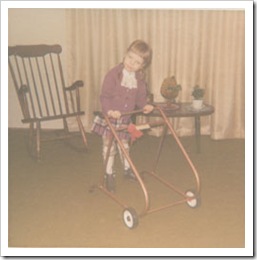
A young Glenda wearing long-legged braces and standing with her walker

With Back to School Fever in the air, I have this small urge to go back to school, if for no other reason than to buy the fun school supplies they have nowadays.

But, seriously, I was one of those strange kids who loved school!

In my autobiography I’ll Do It Myself, I share my first day of school:

I began Grade 1 in my purple heather sweater and purple plaid kilt, treasures from our summer holiday in Edinburgh. I was one bonnie lass!

School was an older building; actually, it consisted of two buildings and a portable. The main building had four or five classrooms for the primary grades, the staff room, changing room and the principal’s office. The older kids were upstairs in the other building, accessible by a long, steep ramp.

As this was before integration and mainstreaming had been invented, all the Special Ed students went to this school, which was actually an annex of a larger school, several blocks away. This was definitely segregation. But, at that age, I didn’t know any differently. I was excited to be starting school with my new notebooks, crayons and lefty scissors. And, I do remember hating missing school when I was sick. It was so boring to stay home.

At this point in this post, I was going to share some of the adaptations that were made for me in the classroom. But, rather than write one lengthy post, I have decided to try something new. After all, isn’t that what going back to school is all about?

From Special Ed Classroom to University GraduateThis post launches a mini series on my school years: the classroom accommodations made during my elementary and high school years through to seven years at university, the successes and struggles I faced, and how school may have been easier had I had the technology that exists today.

By sharing my experiences and lessons learned, I hope to offer ideas and encouragement to parents with children with disabilities who are still navigating the school system, as well as support for older students with disabilities and for teachers who work with them.

This mini series is still very much under development. Your suggestions, ideas and questions are most welcomed and will help to shape this series.

I invite you to come back to follow this series over the next couple of weeks or to sign up using the form in the upper right corner to receive this series and my other blog posts right in your email inbox.

School is in. Let’s see what we learn by sharing and asking questions.


Next miniseries post: Special Ed Class Provides Early Training for the Left Thumb Blogger

If you enjoyed this post, consider buying me a chai tea latte. Thanks kindly.
Related Posts

The Physically Challenged What? Martians?

Filed under: Accessibility 100 — by at 5:57 pm on Saturday, September 5, 2009

Accessibility 100

Yesterday, while exploring a website promoting an upcoming accessibility workshop, I read:

The physically challenged represent approximately twenty percent of the population, and this number is growing.

I was left wondering the physically challenged what? Horses? Cats? People? Which population? Of Mars?

Physically challenged, disabled and handicapped are not nouns; using them as such is grammatically incorrect and impedes comprehension.

Consider the follows three revised sentences:

Sentence #1: Correcting grammar and improving comprehension, the sentence could be rewritten to read:

Individuals with physical challenges represent approximately twenty percent of the Canadian population, and this number is growing.

Of course, sentence #1 assumes the Canadian population is being referenced.

Sentence #2: Assuming the 20% figure includes all disabilities, the following sentence would be more accurate:

People with disabilities represent approximately twenty percent of the Canadian population, and this number is growing.

Sentence #3: Alternatively, the sentence could be rewritten to read:

Canadians with disabilities represent approximately twenty percent of the population, and this number is growing.

By changing the word “people” to “Canadians”, this segment of the population is given a sense of belonging and citizenry. After all, isn’t that what accessibility is all about?

Words can confuse or clarify, simplify or elaborate, demean or empower. Take care in how they are used; otherwise, readers may think you are talking about Martians with physical challenges!


Accessibility 100 is a series of 100 easy-to-implement, free and inexpensive tips for improving accessibility for people with disabilities. This is a community project. Feel free to leave your comments, questions and ideas for future Accessibility 100 posts.

Get the entire series by subscribing to this blog by filling in the form in the upper right corner or by subscribing to the RSS feed.

If you enjoyed this post, consider buying me a chai tea latte. Thanks kindly.

Related Posts

My Response to Nurse Ratchet

Filed under: Advocacy,Living with a disability — by at 2:37 pm on Wednesday, September 2, 2009

Dear East 31 Unit Manager,

On Monday, my husband was discharged from the East 31 Medicine/Neurology Unit after a two-week hospital stay for pneumonia. For the most part, he received good care, for which I am grateful. However, one incident was very upsetting.

Both my husband and I have cerebral palsy and use power wheelchairs for mobility. Yet, we live independently, without any attendant care. We have done a fair bit of traveling without any companions. We work well together as a team, as a married couple, to problem solve and overcome any obstacles.

Saturday afternoon, once his nurse had supervised his safe transfer into his power chair, we mentioned to her that we were going down to the cafeteria for a drink and for a change of scenery. She flipped! She said my husband, who turned 50 today, couldn’t leave the floor without a relative. My husband explained that I am his wife. The nurse told him to wait for his parents, who are elderly. She continued that we would have to take the elevator and that, if something happened, I was “incapable”.

Incapable of using the elevator? Incapable of helping my husband or of summoning help, if needed, in a hospital? The nurse knew nothing about me except that I use a power wheelchair/scooter and that she could not understand my speech. She knew nothing about my capabilities. Labelling me as incapable was not only demeaning and insulting, and dismissed my role as wife; her firm comment was also discriminatory.

Not wanting my husband to experience any reprisal from the nursing staff, we were good disabled people and begrudgingly stayed within bounds.

If the nurse’s comments reflect the unit’s policy, this archaic policy regarding people with disabilities needs reviewing. After all, this is 2009, not 1909!

Thank you for your attention in this matter so that another spouse with a disability is not dismissed in the future.

Sincerely,
Glenda Watson Hyatt

If you enjoyed this post, consider buying me a chai tea latte. Thanks kindly.

Related Posts

Da Wife on Wheels Dismissed Yet Again

Filed under: Living with a disability — by at 11:58 pm on Saturday, August 29, 2009

Being a married couple with both of us with cerebral palsy, there are times when one needs to move aside to allow In someone more capable. And, sometimes that means one of us must go it alone.

Last Monday, when we called for an ambulance because Darrell’s pneumonia wasn’t getting any better on the antibiotics prescribed during the previous Thursday’s trip to the emergency room (ER), the paramedics essentially dismissed da wife on wheels. Only one of them stopped to ask if I’d be okay while the others wheeled away my husband and took the time to understand when I asked, “Which hospital?”

For two days in the ER, I was constantly moving out of the way because there was no room for my scooter. The closest I could get to my husband was the foot-end of the stretcher.

Even once he was moved to a room, there were IV stands, bed tables and curtains to contend with. The only physical contact I had with my husband for the first few days was to rub his feet, which he hates, but it was the only body parts I could reach.

Yet, like any loving and concerned wife, I have made the 9 or 10-block trek on Surrey’s sucky sidewalks, hoping this hospital escapade doesn’t kill this scooter like it did last year, every day except for the day prior to my WordCamp presentation.

Today, on my trek up, I was thinking that if a nurse could be present, as required, while Darrell transferred from the bed into his power wheelchair, then we could downstairs to the cafeteria for a frozen cappuccino or, at least, go outside for some fresh air. I figured this was something we could do together as husband and wife, with minimal effort.

Once Darrell was safely in his chair, he informed the nurse that we were going down to the cafeteria. She flipped!

“No, you must go with a relative.”

“She’s my wife.”

“No, wait for your parents. What if something happens? She is incapable. You’d have go down in the elevator. No. Stay on this floor. Wheel around in the halls.“

WTF? Incapable? Of using the elevator? What could happen to Darrell, strapped into his chair? We’re only going to the cafeteria, for pete’s sake! Besides, I know how to yell for help if I need to!

Without knowing anything about me, except that I use a scooter and that she can’t understand my speech, she, a professional trained and caring nurse, labeled me incapable. She has no clue what I am capable of or how Darrell and I work together as husband and wife. She has no clue about the adventures we have been on or the trips we’ve made. I didn’t see taking the elevator down one floor as an insurmountable excursion!

When I took my marriage vows, no where did I say “…only if others deem me capable…”. Loving my husband means not putting him (or me) at risk, particularly while he is still in hospital recovering from pneumonia. If I didn’t think he could stay upright while driving his chair a few hundred feet and then suck back something other than water or apple juice, I would not have suggested such a risky proposition!

For today, we were good disabled people and didn’t go out of bounds. Tomorrow, Darrell’s mommy and daddy will hold his hands while we go downstairs. That will make the nurse happy…then Darrell and I will make a run for it!

If you enjoyed this post, consider buying me a chai tea latte. Thanks kindly.

Related Posts

Have You Hugged Someone Today?

Filed under: Motivation — by at 1:54 pm on Thursday, August 27, 2009

With my husband being in hospital with pneumonia since last Monday and physical contact being limited by protective garb, i have been thinking a lot about hugs. Like the power of smiles, hugs are free to give, yet can mean so much to receive.

Hugs can:

  • acknowledge an individual’s existence;
  • offer comfort and support;
  • say “I understand”;
  • uplift one’s spirit;
  • offer hope; and,
  • celebrate a moment.

Isn’t it amazing how one simple act can do so much!

I can only imagine the impact fellow SOBCon: Biz School for Bloggers alum Gail Lynne Goodwin and her husband Darryl Slattengren will have when they circumnavigate the world small prop plane,  delivering 100,000 hugs on their Global Hug Tour.

Have you hugged someone today?

Hugs,
Glenda

Technorati Tags:

If you enjoyed this post, consider buying me a chai tea latte. Thanks kindly.

Random Posts

« Previous PageNext Page »