Do It Myself Blog – Glenda Watson Hyatt

Motivational Speaker

Resisting iPhone 3G Mania

Filed under: General — by at 12:49 pm on Friday, July 11, 2008

The must-have-latest-gadget world is buzzing with today’s worldwide release of the iPhone 3G. People began lining up last night at their local mobile phone stores to be among the first to scoop an iPhone.

Combining “a revolutionary phone, a widescreen iPod, and a breakthrough internet device with rich HTML email and a desktop-class web browser,” the iPhone 3G redefines what a mobile phone can do.


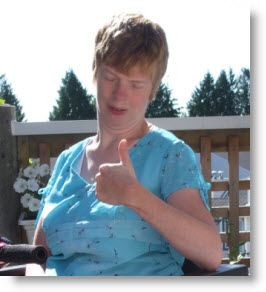
The Left Thumb Blogger awaits release of Thumb 2.0

The Thumb 2.0 will be compatible with all PC and Mac systems, and usable with all applications, including email programs, word processors, blogging platforms and multimedia packages. Its sleek, compact design and universality will ease travel anywhere in the world. The Thumb 2.0 will never encounter system failures, corrupt files or network outages.

Unlike the iPhone 3G, the Thumb 2.0 will not require expensive service plans. Requiring no batteries to recharge, the Thumb 2.0 will not put a further drain on the energy resources nor contribute to the greenhouse gas emissions. And, there is absolutely no risk of causing brain tumours.

Enjoy your iPhone. I will be first in line when the Thumb 2.0 is finally released.

If you enjoyed this post, consider buying me a chai tea latte. Thanks kindly.

Random Posts

Modeling My AFO

Filed under: Living with a disability — by at 11:27 pm on Thursday, July 10, 2008

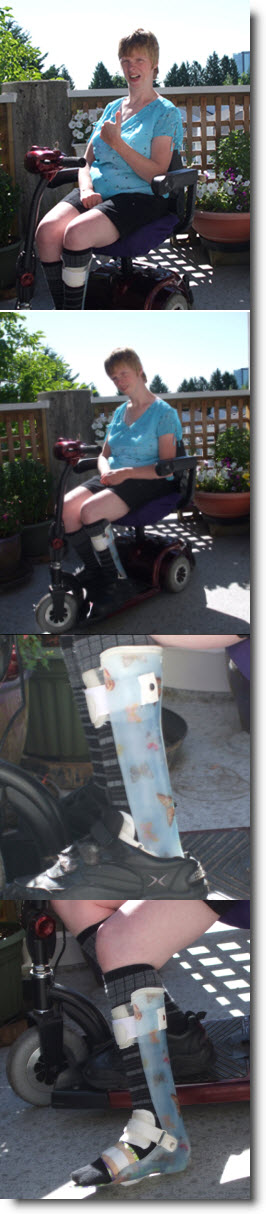
Glenda Watson Hyatt with cerebral palsy wearing her AFO – ankle-foot orthotic
(Photo credit: Darrell Hyatt)

Because a few of you have found your way here after googling phrases like “AFOs”, “cerebral palsy braces”, and “cerebral palsy shoes” – for which I thank you, this post is for those looking for more information on AFOs (ankle-foot orthotics). Having nothing to hide, I gladly share mine with you.

The AFO is a custom fitted brace made from heavy plastic (or perhaps fiberglass, I’m not sure, but it isn’t as heavy as the metal braces from the old days). The process begins with a casting. It took three casts to get my foot and ankle in the best possible position. I was sore afterwards, after having my body torqued in directions that it doesn’t usually go.

Then there were a few more appointments for further tweaking to make it as comfortable as possible. Imagine making a stiff, hard casts comfy. No matter what is done, it doesn’t feel like bedroom slippers!

Some AFOs have articulated joints at the ankle. The doctor wasn’t that kind to me. My foot doesn’t move at all! This makes getting up into the standing position because I’m teetering on my heel until I’m fully up and can put my foot flat on the ground. Not great for someone with tenuous balance at the best of times!

Because of the width of the AFO (also dubbed the Anti Fashion Object), I must wear wide men’s shoes, thankfully with Velcro fasteners. I’m searching for ultra girly tops to counterbalance the male bottom.

To be honest, I am not keen to be back in a brace. I thought suffered through triple arthrodesis surgeries the summer before Grade Six, many moons ago, freed me from braces forever. But, the surgeon did warn the bones may slip at some point in the future, which I feel occurred a few years ago even though today’s doctors say nothing has moved – not that they’ve compared current x-rays with post-surgery ones. My ankle has been sore and slightly swollen most days for these past few years.

Wearing the AFO does put my ankle in a better position. Some days it relieves the pain. Other days it exacerbates the discomfort. I choose when I wear it. If I am going out and may be using less than ideal washrooms, where I need to be solid on my feet, I don’t wear it. And, on these hot summer days, when my ankles swell anyway, forget it! If my foot is extra sore, I put the thing on to try to get some relief. Because I’m now an adult, I now have that choice!

For parents researching AFOs for their child with special needs and for adults with disabilities facing the possibility, I hope this helped. Feel free to ask any questions you may have and I’ll try to answer them.

If you enjoyed this post, consider buying me a chai tea latte. Thanks kindly.

Related Posts

Accessibility: A Personal Perspective

Filed under: Accessibility 100,Living with a disability — by at 3:06 pm on Friday, July 4, 2008

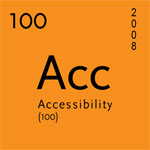
Accessibility 100

When talking about accessibility, it is easy to get caught up in the necessary width of doorways, the need for ramps built at a certain incline, and the height to install grab bars in wheelchair washrooms. And, of course, the cost of it all! But, what is often missing from the discussion is the why. Why go to the bother and cost of making places accessible? Why does it matter?

Please allow me to share my “why”:

On Tuesday, my husband and I, both wheelchair users, decided to go out to celebrate our nation’s birthday with fellow Canadians. Without a definite plan in mind, we took the Skytrain into Vancouver. When the elevators are working, the Skytrain is an easy mode of transportation for us. We merely wheel into a train car and then wheel off at our destination.

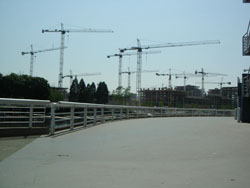
2010 Olympic Athletes Village under construction

Getting off at the Main Street/Science World Station, we first took in the progress of the Athletes’ Village for the 2010 Olympics. What an amazing sight seeing a dozen cranes in one location! All of them operating at once must be quite a dance.

Then we followed the path around False Creek, with the rest of the cyclists, inline skaters and walkies. This route is one of our favourite outings because it’s nicely paved and bricked, fairly flat and no car traffic to watch out for. We can go for miles without needing to contend with barriers.

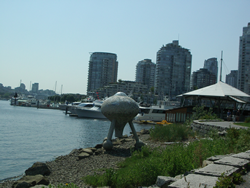
View of False Creek

Some of the sights leave us puzzled though. We have no clue what this tripod structure is: a piece of abstract art, a marker of some kind or alien spaceship?

We stopped at Urban Fare for a bite and our first iced mocha. Those could be addictive!

At my age, I have learned not to pass by an accessible washroom without using it – there isn’t always one around when needed. Urban Fare’s accessible washroom was pretty good; definitely doable – and that is what counts!

From False Creek, we headed across downtown to Canada Place, grateful that there were sidewalk curbcuts on every corner. Where possible we avoided a few curbcuts that either were a little too steep or went out into of oncoming traffic.

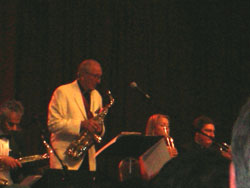
Dal Richards performing at Canada Day

Unknowingly we arrived at Canada Place in time to catch Vancouver legend Dal Richards and his band perform. Watching him took me back to the early days of the Variety Club Telethon where he conducted the orchestra for the entire twenty-two hours. Now at 90, I’m sure it is his passion for music that has kept him so young!

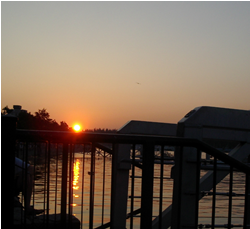
Sunset at Harbour Park

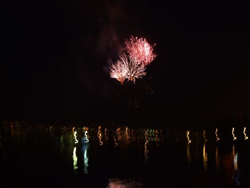
With the festivities at Canada Place over, we found our way down to Harbour Park to wait for the fireworks. Alternative sidewalks around construction sites were accessible. Long ramps at the park made it possible for us to get down the harbourside, which gave us a perfect vantage point.

Once again, I didn’t pass up the opportunity to use the public washroom, which was, again, quite accessible.

After putting several miles on our chairs, we took the Skytrain back home to Surrey.

Canada Day 2008 Fireworks
(Photo credit: Darrell Hyatt)

I honestly do not know how much it cost to make that day accessible for us and other wheelchair users, for parents with baby strollers, for cyclists and for others on wheels. But, I do appreciate being able to get out in the community like that.

Being able to “ooh aah” fireworks with fellow Canadians: priceless!


Accessibility 100 is a series of 100 easy-to-implement, free and inexpensive tips for improving accessibility for people with disabilities. This is a community project. Feel free to leave your comments, questions and ideas for future Accessibility 100 posts.

Get the entire series by subscribing to this blog by filling in the form in the upper right corner or by subscribing to the RSS feed.

If you enjoyed this post, consider buying me a chai tea latte. Thanks kindly.
Related Posts

2008 in Review – So Far!

Filed under: Blogging,Motivation — by at 12:35 pm on Tuesday, July 1, 2008

Proudly waving my Canadian flag

Where the heck does the time go? 2008 is already half over! Canada Day is already here, marking the beginning of the second six months of the year.

I figure it is good time to review my goals for the year and see how I am doing.

My Contribution to the Blogosphere

My goal was to comment on ten blogs per week – five comments on blogs I had previously commented on to further strengthen those relationships, and five comments on new-to-me blogs to expand my network by forming new relationships.

Well, results are less than stellar. Some weeks Friday comes around and I realize I haven’t made any comments! By now, I should be approximately halfway to 520 (or 260) comments; yet, my total is only 89.

However, I am not including the comments I make on Disaboom blogs since they don’t link back to this blog. Besides, reading Yaro Starok’s Blog Profits Blueprint, I’ve learned that blog comments create traffic streams, not traffic rivers. Although, my intention was to contribute to the blogosphere, not to generate traffic – that’s a side benefit of leaving comments.

Am I beating myself up for not meeting my goal? Nope! Those weeks that I can do better, I will try. The world will not end if I don’t reach 520 comments by December 31st.

My Word for the Year

I chose FOCUS as my word for 2008. To me, FOCUS entails minimizing my technologically-induced ADHD, decluttering and simplifying my surroundings, multi-tasking only when appropriate – tasks requiring my full attention will receive it. The results have been mixed.

When my husband had an unexpected two-week hospital stay in March, nothing else mattered. I was focused on what was happening with him and getting him well and home again, as I should be.

My desk remains fairly clutter free. The rest of my office still needs decluttering – like I have had time!

After blogging at Disaboom for five months, I finally found my blogging groove there and have a direction for that blog. That made writing June’s posts much easier because I wasn’t scrounging for post topics. June is the first month I maxed out the number of paying posts I can write for that blog. Can I continue that through July and beyond?

Reading ProBlogger: Secrets for Blogging Your Way to a Six-Figure Income by Darren Rowse and Chris Garrett reconfirmed, yet again, that blogging is my future and that I can make a decent income from it – if I focus and work off my bootie! I publicly declared my goal of attending SOBCon 09 – the business school for bloggers – to learn how to become a better and more effective blogger. My ultimate goal is to become the first ever Six-Figure Left Thumb ProBlogger!

Launching Accessibility 100 has provided my blog with some direction and focus.

But, I still suck at curbing my technologically-induced ADHD! I’m easily distracted by email, Twitter or whatever rather than focusing on the task at hand. There is definitely room for improvement. I’ll keep working to maser my high distractibility over the next six months.

My Bucket List

Wow, search engines love my bucket list! Currently, this is the top-ranking entry page on my blog. Go figure!

  • Spend more time with my kitty purring in my ear. – I do whenever she decides to cuddle.
  • Listen more to my husband’s beating heart. – We’ve talk quite a bit and I try to really listen to him. I also like listening to his heart beat; it’s such a comforting and reassuring sound.
  • Write love letters to him. – None yet. Expressing what he means to me is difficult to put into words.
  • Find a way to get to the north shore to watch the eagles soar. – I still need that magic carpet ride!
  • Meet more of my invisible friends. – Yes! I’ve met Suzie Cheel in Australia and Todd Jordan from Missouri!
  • Be in the ‘real’ world more. – Hmm, how should I measure “more”?
  • Connect with more of my invisible friends in a real way, if I can’t meet them in person yet. – I’m working on it.
  • Become more physically active. – In this heat? Are you kidding!
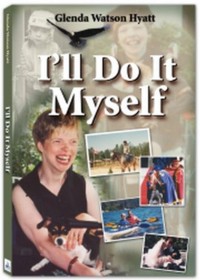
  • Finish selling the first print run of my autobiography. – Autographed copies are still available!
  • Continue searching for a cp-friendly bra. – Still searching! (I don’t believe I included this here.)
  • See Anne Murray in concert, finally! (I’ve wanted to see her for years and she is finally coming to town on May 5th!) – She was fabulous!
  • Get organized for when I do kick the bucket. – It’s a good thing I haven’t kicked the bucket yet!
  • Make a positive difference or impact on people’s lives. – I hope I am. You, my readers, are in a better position to say whether I’m succeeding here or not.
  • Reconnect with my penpal Paivi and my Brownie friend Karen. – Yes, I’ve managed to find email addresses for both and have contacted them!

That is my six-month progress report. Not bad, eh?

How are you doing with your 2008 goals? Are you still on track or do you need to refocus?

If you enjoyed this post, consider buying me a chai tea latte. Thanks kindly.

Related Posts

What is in a word? The evolution of disability language

Filed under: Accessibility 100,Blog Accessibility — by at 3:39 pm on Tuesday, June 24, 2008

Accessibility 100

Cripple. Handicapped. Disabled. Physically challenged. Person with a disability. It doesn’t really matter what term is used, does it? After all, is not a rose by any other name still a rose?

Anthropologist Bronislaw Malinowski suggested that “language and culture are indivisible, our language is our culture and how we use it reflects on our culture.” (Quoted from Susan Balandin, Susan. “Transitions – A lifelong journey.” School of Communication Sciences and Disorders: The University of Sydney.) Through history, culture has dismissed, discounted, and discarded those seen as different or disabled. Preoccupied with physical perfection in ancient Greek times, infants who did not measure up were drowned in the river. In medieval times, the disabled, feeble-minded, and malformed were court jesters and exhibitions at freak shows — things to be laughed at, ridiculed, and feared. More recently, the disabled were the first group to be murdered by the Nazis.

An indicator of a society’s regard for the disabled lays in the terms used to label them. For example in English, invalid means “not valid” or “not acceptable.” Handicap conjures up an image of someone on the street corner with “cap in hand,” begging for handouts and charity. These labels degrade individuals by focusing on their differences or incapabilities, rather than on the individuals themselves. Labels link individuals to stereotypes, and often trump other indicators of identity. People use labels as a form of mental shorthand, for example, the disabled, the homeless, single-parents, and so on.

Until recently, the prevalent model of disability has been the medical model in which the disabled person is seen as the problem: “We are to be adapted to fit into the world as it is.” In this model, terms frequently used include confined to a wheelchair, housebound, suffers from, stricken with, needs help, needs a cure, can’t walk, can’t talk. Usually the focus is on the impairment, rather than the needs of the individual. This language emphasizes dependency, pity, fear and patronizing attitudes and reinforces negative stereotypes of disabled people. In this model, “most disablement is created by oppressive social systems.”

In the late 1980s, largely influenced by people with disabilities themselves who argued that disability is a socially constructed concept and society itself creates the disability, there was a shift from the medical model to the social model. In this model, prejudice, discrimination, and inaccessible environments are the disabling factors, rather than the medical conditions.

The social model of disability highlights the use of language to disempower, as the medical profession and government imposed limiting and negative labels. This type of language is used as a way to control, dominate, and subtly or blatantly discriminate. This model gave way to the empowerment of people with disabilities through the development of a vigorous disabled identity and self-advocacy movement.

Then, language around disability began to change:

“.…we are not ‘the disabled.’ We are disabled people, or even people with disabilities. It is important that we do not allow ourselves to be dismissed as if we all come under this one great metaphysical category ‘the disabled.’ The effect of this is a depersonalization, a sweeping dismissal of our individuality, and a denial of our right to be seen as people with our own uniqueness, rather than as the anonymous constituents of a category or group.”

For the first time in history, people with disabilities were finding their voice in determining which terms would define them. The result was a widespread social realization that the disabled population is not a homogenous group, but rather a group of individuals often lumped together—as many stereotyped groups are—despite differences in experiences, beliefs, needs, and goals.

Society no longer knew what to call these newly empowered people. Not wanting to upset or offend them, society grappled for more socially acceptable terminology: physically challenged, visually impaired, differently abled, disAbled, and so on. Canadian songwriter Jane Field expressed this sentiment in The Fishing is Free:

No one knows just what to call us
which label should befall us,
And they’re some dandy terms from which to choose.
My favourite’s “wheelchair-bound” ‘cause it has a
bondage sound.
Oh it’s fun to guess what term they’re going to use.

Although the terms used to refer to people with disabilities are evolving, the language used to describe their experiences seem to be still somewhat medicalized. Able-bodied individuals exercise, workout, and have personal fitness trainers, while individuals with disabilities get rehab, therapy, and have physiotherapists. Able-bodied children take music lessons, children with disabilities receive music therapy. Able-bodied children do swimming lessons, children with disabilities get hydrotherapy. Such language still implies a sense of dependency and inferiority; a sense that the experiences are happening to the individual, rather than the individual being actively involved.

There is still some distance to go before people with disabilities are acknowledged as equals in society. The use of language and choice of words go a long ways in empowering and liberating, and thus, creating equality. For example, one wonders if the labels Olympians and Paralympians are viewed equal, as having the same high-quality of athleticism, determination, and commitment. Is this differentiation between athletes necessary? What purpose does this distinction serve? What stereotypes are reinforced?

Words can hurt or they can heal; they can disempower or empower; they can reinforce negative stereotypes or enlighten. Consider the language you use everyday. Does it convey the right message?

Empower Your Words

When communicating, choice of words can be quite empowering and liberating.

Words like gimp, cripple, and handicapped convey a different image than a person with a disability, a man with multiple sclerosis, or a businesswoman with cerebral palsy.

If you are unsure of what terminology is appropriate, keep these three simple tips in mind:

  1. Put people first, not their disability.
  2. Individuals with disabilities have different preferences regarding terminology. To ease awkward situations, simply ask the individual what he or she prefers — if such terminology is even necessary in the situation.
  3. Remember, we all have names. If the particular situation does not require disability-related terminology, simply use our names, please.

The key is to speak to and refer to people — all people — in a respectful manner.

(Originally written for SPARC BC News, Fall 2005.)


Accessibility 100 is a series of 100 easy-to-implement, free and inexpensive tips for improving accessibility for people with disabilities. This is a community project. Feel free to leave your comments, questions and ideas for future Accessibility 100 posts.

Get the entire series by subscribing to this blog by filling in the form in the upper right corner or by subscribing to the RSS feed.

If you enjoyed this post, consider buying me a chai tea latte. Thanks kindly.
Related Posts

« Previous PageNext Page »