Do It Myself Blog – Glenda Watson Hyatt

Motivational Speaker

The Cushion Saga Continues

Filed under: Living with a disability — by at 1:51 pm on Friday, May 18, 2007

The gloriously full moon
(Photo credit: Tue Romanow)

A couple of weeks ago, I shared how my husband Darrell needs to jump through disablistic hoops to get a new gel cushion for his manual wheelchair. As a quick update, the occupational therapist (OT) – the one who assessed Darrell last year for his new electric chair – called yesterday to say his file has now been reopened, but first Darrell needs his doctor to fill out the Ministry form before the OT can assess for the exact same cushion that is on the power chair. Why didn’t the OT mention this step to Darrell two weeks ago so that he could have booked a doctor’s appointment while waiting for his file to find its way back to the OT’s desk?

The OT suggested that, in the meantime, Darrell park both wheelchairs beside the bed, transfer to the bed, swap the cushion from one chair to the other, and then transfer to the other chair. Darrell and I aren’t sure how he, himself, is supposed to get both chairs to his side of the bed and then get out again. It comes back to levitating – a skill neither one of us has mastered yet.

He does have a doctor’s appointment for the 28th to have the doctor fill out the same form as he did less than a year ago. No doubt, the doctor will charge us the same fee for completing a form! Unless I’ve missed a memo in the last forty years, cerebral palsy is still a non-progressive, lifelong neurological disorder. Why not stamp CP on our foreheads and be done with it? Save a few trees in the process. Better yet, stamp it on another body part – I would gladly moon a few bureaucrats!

Stay tuned…

Have a great long weekend, my Canadian friends!

If you enjoyed this post, consider buying me a chai tea latte. Thanks kindly.

Random Posts

I Would Eat My Vegetables If I Could Cut Them

Filed under: Living with a disability — by at 1:55 pm on Thursday, May 17, 2007

A variety of neatly cut fresh fruit
(Photo credit: Meliha Gojak)

In British Columbia, there is a strong push to get people eating more fruit and vegetables by the 2010 Olympics and Paralympics.

It’s not that I don’t find grocery store displays of brightly coloured fruits and vegetables tempting. It’s not that I don’t enjoy experiencing the crunch, texture and taste of a variety of fresh fruits and veggies. It’s the cleaning, peeling and chopping that I find deterring.

With my husband and me both having cerebral palsy and, thus, limited hand function, we rely on frozen juice from concentrate, frozen vegetables requiring minimal effort to cook in the microwave and easy-to-eat fruits, like grapes and bananas. We also take a multivitamin supplement fill in any gaps in our diet.

Last Friday, in a spirit of adventure and in attempt to broaden our culinary capabilities, we purchased a Starfrit Rotato Express and a Quick Chop as seen on TV. Sunday afternoon, in what felt like an occupational therapy session, we figured out how to safely use these time-saving kitchen devices. The Rotato was slick, peeling potatoes and an orange in mere seconds. The orange was so juicy and tasty!

The Quick Chop required most work than shown on TV as the pieces need to be cut to fit inside the chopper and then the chopped bits needed to be separated. It was as fast to manually tear the green peppers into bite-size pieces. Besides, precisely cut pieces don’t enhance the taste or nutritional value. It is yet to be determined whether the Quick Chop emains on active duty or dishonourably discharged to the back corner of a cluttered kitchen cupboard.

As I was wiping off the Rotato, I had a cp moment and my finger went flying across a sharp piece. Instantly I had a red geyser. Thank goodness it wasn’t my typing thumb!

My next mission is to find steel fingertip gloves. Alternatively, we stick with bananas and vitamin pills until we can afford a personal chef!

If you enjoyed this post, consider buying me a chai tea latte. Thanks kindly.

Random Posts

My First Blog Carnival

Filed under: Blogging — by at 1:22 pm on Thursday, May 10, 2007

Disability Blog Carnival

I have eagerly awaited this day for a few weeks. Today, I am participating in my first carnival; blog carnival, that is. This is the closest I’ll come to joining the circus!

According to the Wikipedia, a blog carnival is:

…similar to a magazine, in that it is dedicated to a particular topic, and is published on a regular schedule, often weekly or monthly. Each edition of a blog carnival is in the form of a blog article that contains permalinks links to other blog articles on the particular topic.

…typically, someone who wants to organize a carnival posts details of the theme or topic to their blog, and asks readers to submit relevant articles for inclusion in an upcoming edition. The host then collects links to these submissions, edits and annotates them (often in very creative ways), and publishes the resulting round-up to his or her blog.

There are hundreds of blog carnivals on every conceivable topic. If there isn’t one on your particular topic or interest, then it’s easy to start one. Carnivals are a great way to build community, to organize posts around particular topics and to increase visitors to your blog.

I have been reading the Disability Blog Carnival for a few months and decided to give it shot. Coincidentally, my first carnival is themed “firsts”; hence, my post Firsts Expand Our Comfort Zones So Dreams Are Reachable. Visit The Gimp Parade to enjoy the rest of the carnival!

If you enjoyed this post, consider buying me a chai tea latte. Thanks kindly.

Random Posts

Firsts Expand Our Comfort Zones So Dreams Are Reachable

Filed under: Living with a disability,Motivation — by at 7:32 pm on Sunday, May 6, 2007

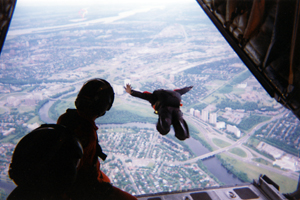
Skydiving - expanding your comfort zone
(Photo credit: Jeff Hallam)

Growing up labeled as “functionally non-verbal”, I only spoke to those close to me; those who were patient with Glenda-ish. It wasn’t that I didn’t have anything to say to other people (oftentimes, quite the opposite!); it was simply easier to remain non-verbal. Although it was frustrating many times, it was comfortable. I wasn’t expected to give a class presentation or an oral report; a written assignment was an acceptable substitute.

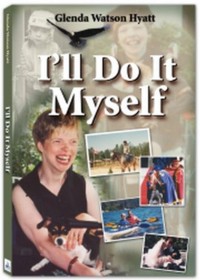
Every so often in life, if you are lucky, situations or opportunities come along that stretch your comfort zone beyond recognition and leaves you with abilities or talents that you didn’t know were within you. Such an opportunity presented itself to me in April, 2005, when I was asked to speak at the Social Planning and Research Council of British Columbia’s (SPARC BC), “Beyond the Obvious: Exploring the Accessible Community Dialogue”. As I shared in my autobiography I’ll Do It Myself:

My initial thought was But I don’t give speeches. I can’t. Since I was raised without the word “can’t “in my vocabulary, that was a fleeing thought. I quickly turned my thought to How can I do this?

I had been using the free computer software ReadPlease for a couple of years to proofread my writing. ReadPlease reads aloud text that is copied into the program. I thought, Maybe I could put ReadPlease onto my laptop and have it read aloud my speech for me. I hesitantly agreed to speak. Unsure if the technology would work, I took a printed copy of the speech with me, in case I needed someone else to read it on my behalf.

Finally, it was my turn to take the stage. Being on stage alone for the first time in my life, with two hundred eyes staring at me, I wanted to run. But, I didn’t. I gave my speech. When I was done, I left the stage, trembling. I had given my first ever speech! And the technology worked!

Afterwards something amazing happened. For the rest of the day people actually came up to me and spoke with me. I was heard for the first time. I was no longer invisible, no longer silent. It was an amazing, unexplainable feeling that I would like to experience again. I would like to give more speeches. I would like to be heard again.

This first speech pushed me beyond my comfort zone. The days and moments leading up to my speech were terrifying. I knew my athetoid cerebral palsy would kick into high gear and my head control would vanish, leaving me bobbing for invisible apples. But, because I took the risk, I experienced a moment that I would not have had otherwise. And, I realized something about myself: that I could present a speech AND survive. Perhaps the apple bobbing wasn’t quite as bad as I feared.

At the end of June, I am offering a web accessibility training session for the Information Technology (IT) staff for a local city – another first for me. I am scared; this is so far out of my comfort zone. But, I know I will survive and that it will be an amazing feeling when I come out on the other side. And, it could quite possibly open doors that I do not know even exist yet.

Taking the risk to try something pushes us out of our known comfort zone and forces us to grow and to realize awesome things about ourselves. Stretching beyond our comfort zone is when dreams are reached.

What first can you take to expand your comfort zone to reach your dream?

If you enjoyed this post, consider buying me a chai tea latte. Thanks kindly.

Random Posts

Medical Professionals Are the Worst Disablism Perpetuators

Filed under: Advocacy,Living with a disability — by at 12:18 am on Sunday, May 6, 2007

Despite taking an oath “to do no harm”, medical professionals are the worst at perpetuating disablism. Many of them do not see beyond the disability, disease or disorder to see the individual filled capabilities, potential and dreams. They use language that focuses on the deficit rather than on the positive. And, once an individual is diagnosed with a disability, then every future ailment is presumed related to that disability and is often discounted or completely disregarded.

I would like to share my most recent experience with medical professionals. For a bit of background: many, many moons ago, I had a triple arthrodesis done on both feet – surgery that, essentially, rearranged bones in my feet to stabilize my ankles, which were beginning to go over on their sides when I stood up. Despite the months of pain, the surgery was a success. I graduated from the heavy, metal long-legged braces to ones below the knee and then to none. However, the pediatric orthopedic surgeon warned that the bones may slip at some point in the future.

Fast forward to six years ago: bones in my left foot felt like they were grinding on each other, and the two protruding bones seemed to be protruding slightly more. When I showed my family doctor, his comment, in a patronizing tone, was, “Our bones tend to protrude as we get older,” at which point I was very tempted to have an intentional involuntary movement with my foot making forceful contact with one of his sensitive body parts. I was sent for x-rays, which, with athetoid cerebral palsy and constant movement, is another story.

Over the years I have shown my permanently swollen ankle to various doctors with little concern in return. One doctor did send me for more x-ray – another exercise in frustration. The radiologist report came back saying something like, “Paraplegic patient has no broken bones.” Up until this point, I had been a quadriplegic, meaning that all four limbs had been affected. Wow, a paraplegic! I had been half cured and hadn’t even realized it.

August, 2005, I was in for my annual thrill and asked the gynecologist for a referral to an orthropod. Her nurse chose a name from the yellow pages, further diminishing my confidence in the healthcare system.

After another fourteen months of pain, I finally had an appointment with an orthopedic surgeon, not that those are comforting words to me. Finally someone took interest in my foot. With more x-rays, it was determined that bones have not moved. Without comparing these x-rays with the post-surgery x-rays from years ago, I’m not sure how this determination can be made, but I’m not the highly educated, highly paid expert. The news that I don’t need surgery was a relief; I was dreading having to go through that painful experience again. He referred me to a brace maker; another idea that didn’t thrill me, but definitely better than undergoing the scalpel again.

November 3rd, 2006 – a day I remember well, although not fondly. We were caught in one of Vancouver’s worst ever downpours and Darrell’s electric wheelchair shorted out. We were soaked! The alleged brace maker turned out to be Rehabilitation Specialist of some sort. I have a semantic issue with rehabilitation and cerebral palsy. According to the Merriam-Webster Online Dictionary, to rehabilitate means “to restore to a former capacity”. Cerebral palsy occurs during or shortly after birth. There is no former capacity to restore.

Putting labels aside, this doctor proceeds to ask us a ton of questions unrelated to my foot, and adds, “I’ll ask you (indicating me) the questions, but I want your husband to answer to save time.” And this specialist is supposed to work with individuals to regain independence and self-reliance? It is interesting how medical professionals can least understand Glenda-ish. Any correlation with the amount of time they spend listening to their patients?

Almost as afterthought, he examined my foot. I was cold and wet, and he told me to just relax. Does this specialist know anything about athetoid cerebral palsy? A relaxed state is not something I can turn on and off on command. He concurred that I need a brace of some sort and referred me to an orthotist.

After a ten-minute appointment, Darrell and I left St. Paul’s Hospital and headed back into the downpour, at which point Darrell’s three-month-old wheelchair completely and totally died. We needed to get from downtown Vancouver to our home in Surrey. Darrell desperately called his friend who works at the University of British Columbia. Thanks to his friend pushing Darrell in his heavy chair to the Skytrain and then up the hill, we eventually made it home.

Friday, after a couple of canceled appointments due to bad winter weather, I had the first appointment with the orthotist, the brace maker. The appointment was off to the typical start of taking a history and ascertaining why I was there, but I had hope for her because she was listening to and, for the most part, understanding Glenda-ish. Then the Rehabilitation Specialist arrived late and the staff stood around discussing an upcoming conference and other clients – on my appointment time! I heard him mentioned he didn’t have my file because his secretary was on holidays, the replacement secretary couldn’t find the file or the dictation file on the computer. Considering she called me “Hyatt” when she phoned with the appointment time, my haunch is my name got messed up on the file, which subsequently was misfiled – another insignificant medical error.

Practicing some patience, they eventually rejoined Darrell and me in the exam room: two orthotists the rehab specialist, a physiotherapist, and a student, of course. They took turns poking and twisting my foot. Then they began discussing me as if I wasn’t there. I tried interjecting, particularly when the word botox came up. I said I would need a lot more information first, to which the specialist annoyingly replied, “Of course. We’re only strategizing.” Strategizing about me without me? I told Darrell that I’d rather have a rum and coke than botox to relax me for the casting. Unfortunately that didn’t get translated.

Not one of the four professionals explained the problem with my foot, what these braces or AFOs (ankle-foot orthotics) are like nowadays, or asked for my input. Some things haven’t changed in forty years, although I didn’t need to strip down to my underwear this time. I left with a sore foot and leg, and feeling less than an intelligent, independent and capable woman. In a way, I had been stripped. Would I have been treated the same way had I been an articulate able-bodied individual?

From what I understood from the discussion going on around me, a partial correction is probably the best that can be hoped for. My question is: if it hadn’t taken six years to get to this point, might the outlook be better? If I had been taken seriously by my family doctor back then, before my foot became worst, would a complete correction have been possible? Would this process have been quicker if I didn’t have cerebral palsy? Would I have been taken more seriously had I been a star athlete or a highly paid executive? How many doctors do I need to see in order to be heard?

These medical professionals can take a few lessons from the United Kingdom’s Good Medical Practice (2006), which “sets out the principles and values on which good practice is founded.” The duties of a doctor include:

  • Treating patients as individuals and respecting their dignity and right to confidentiality;
  • Working in partnership with patients by listening to them and responding to their concerns and preferences, and giving patients the information they want or need in a way they can understand; and
  • Respecting patients’ right to reach decisions with you about their treatment and care.

It would be so refreshing to have all doctors treat me in this manner. Is that too much to expect?

If you enjoyed this post, consider buying me a chai tea latte. Thanks kindly.
Random Posts

« Previous PageNext Page »