Do It Myself Blog – Glenda Watson Hyatt

Motivational Speaker

Point, Click and Wheel

Filed under: General — by at 3:49 pm on Monday, May 2, 2011

My most upsetting moment on my recent trip to Austin wasn’t waiting four hours for a wheelchair taxi, getting on stage, or even missing my flight to San Diego.

My most upsetting moment was dropping and breaking my camera on Day 2 of South by Southwest (SxSW). I was lost without it. What is a blogger without a camera?

new-camera
(Photo credit: Darrell Hyatt)

That devastating lost was soothed this weekend with a trip to Black’s and the purchase of the Olympus TG-310. Being waterproof and shockproof I can now drop it in a puddle without any ill effects. And, the red matches my scooter – colour is an important consideration when choosing a camera! 😉

Yesterday, during a brief spell of quasi spring weather, Darrell and I went on a photo wheel around our neighbourhood. Here are a few highlights:

These three trees are my favourite sign of spring in the neighbourhood. They will be loaded in pink blossoms in a few more days…

Trees on the verge of full bloom

Viewing the SkyTrain tracks from underneath is an interesting perspective, kind of artsy…

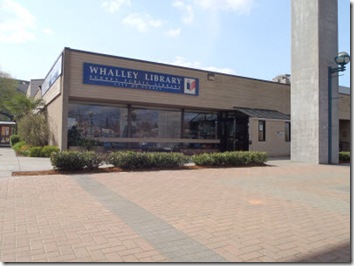
Our existing Whalley Library…

Small, old Whalley library

Our new library to open in the Fall. I can’t wait!

Large, modern Whalley library under construction

A brightly coloured touch of spring…

Red and yellow tulips

Darrell and I ended our pleasant photo wheel at Tim Horton’s, of course…

Tim Horton's coffee shop

Enjoying my mocha latte, I looked over at another table where a group of four had just sat down. My jaw dropped and my eyes popped out of my head. There on the table was a camera with, I swear, an 8-9 inch lens. I had instant camera envy! Sigh. One day…maybe… For now, I will enjoy my new red one.

Technorati Tags: ,,

If you enjoyed this post, consider buying me a chai tea latte. Thanks kindly.

Related Posts

Creating Safe Places Encourages Communication with iDevices

Filed under: Living with a disability — by at 3:23 pm on Tuesday, April 26, 2011

In my last post Wanted: AAC Role Models, Leslie Porter asked a question that I feel deserves a response in a separate post rather than being buried in the comment section:

Reader's Question

I am appreciative of your article. I have a 15 year old daughter who has athetoid cp as well. We have read your book and she could so relate to many situations. She has had an ECO 14 device for years but getting her to use it has been difficult. We got an iPad and Proloquo2Go last year or so but she is so reluctant to use it so she sticks with talking to close friends and family and being quiet in new settings. Just last week she said she would like to “talk more” but I think having the iPad as a viable option to her speech (which new people have a hard time understanding as you well understand) would really help but she needs safe opportunities and role models to get to a point she is comfortable using this. Any suggestions?

Glenda's Response

Leslie, thank you for asking such a great question! Hopefully by responding in a separate post, it’ll spark a lively discussion and others will offer suggestions in addition to the ones I’m about to share based on my own experience.

From my experience over the last few years, I have realized how much of a factor confidence plays in spontaneous face-to-face communication. Confidence that what I am about to say is relevant to the current conversation; confident that it doesn’t sound stupid or inappropriate. And that confidence is built over time.

As you mentioned, communication requires feeling safe. On my recent trip to South by Southwest (SXSW) in Austin and then the 26th Annual International Technology & Persons with Disabilities Conference (CSUN) in San Diego, many of my online friends who I had previously met face-to-face were at SXSW. There was already a sense of familiarity and intimacy with them. Communicating with some meant using the iPad for the occasional word when they were stumped on Glenda-ish; with others it meant using the iPad for the majority of the interaction. Either way was fine, and each successful exchange gave my self-confidence a little boost.

When I arrived at CSUN where I knew relatively few people, I was feeling confident in using my iPad for communicating. Also, I found the CSUN environment and people very accepting. i felt safe in using my iPad to communicate, which further boosted my confidence.

Leslie, I would suggest encouraging your daughter to begin using the ECO 14 device or the iPad (the situation might determine which device is more appropriate) with family and close friends – although I realize that may be clumsy if they all already understand her dialect. It may take a conscious effort to encourage her to use her device of choice. Reward the small successes. Then gradually increase interactions with people less familiar with her, and try other kinds of interactions like ordering a burger in the food court, making a hair appointment or whatever.

If your daughter uses the grid view in Proloquo2Go, add teen appropriate language, like her favourite movies, bands or current hotties and any relevant local words to help facilitate communicating with her peers at school. If appropriate, involve her in the process of adding the words. If she can do it herself, awesome!

As for role models, that may be a little more tricky to find. Many of the YouTube videos are of younger kids with autism or cerebral palsy using Proloquo2Go, which may not inspire a teenaged girl. My Twitter friend Leanne Stewart did come across Lyn Levett who uses her iPad with her nose.

On her blog, Katilea shares her journey living with Ataxia. The iPad with Proloquo2Go has been a life-changer for her. Kati is a whiz at creating new pages in the app.

I have shared many of my iPad adventures here on this blog, and  I now see capturing a few of those adventures on video would benefit others. I will work on that.

Other places to find willing role models might be local disability groups, rehab centres, employment programs for people with disabilities, colleges and universities.

Hopefully my readers will have other suggestions for finding role models using the iPad for communication.

Leslie, your daughter’s desire to “talk more” is the first step. Encourage her to communicate in safe situations. Gradually those situations will grow as her confidence increases. Role models, close by or from afar, will help teach her to communicate in this manner, in ways teachers, therapists and parents can not. Follow the pace she sets for her journey.

Good luck and please let me know if you have any more questions.

If you enjoyed this post, consider buying me a chai tea latte. Thanks kindly.

Related Posts

Wanted: AAC Role Models

Filed under: Living with a disability — by at 6:57 pm on Thursday, April 21, 2011

On my recent trip, I was very grateful for my iPad and the newly acquired ability to communicate with anyone:

  • While waiting at the Dallas airport for the delayed flight to Austin, I chatted with Steve who was also on his way to South by Southwest (SXSW).
  • My first night at SXSW, I had supper with my friend Todd Jordan. It was one of those meals when more talking than eating took place.
  • Wandering the SXSW Exhibit Hall, I had a nice chat with Patti Hosking from BlogWorld Expo.
  • While waiting for the airline customer service rep to arrange an accessible hotel for my unscheduled stopover in Phoenix, I was able to tell her I was not deaf; there was no need to communicate via notes to me.
  • Exploring the 26th Annual International Technology & Persons with Disabilities Conference (CSUN) Exhibit Hall, I was able to ask questions about a particular device on behalf of a friend.
  • After my CSUN presentation, I ordered celebratory iced mocha and then tweeted:
    GlendaWH: Scored an iced mocha. Loving my ipad and proloquo2go! #csun11 17-March-2011
  • At the Holiday Inn, I was able to arrange for the accessible shuttle to the airport.
  • And the list continues…

When I had realized how much more I was able to interact with people not fluent in Glenda-ish, the questions struck during a quiet moment at CSUN. How had I travelled and attended conferences before my iPad? How much had I missed out on by not having a communication device? Who had I missed interacting with? What opportunities had I missed? How different might high school and university have been? Might I have been successful in finding a job after graduation?

Yes, previously, I used my alphabet card and typed many notes for communication. Those methods worked for brief encounters. But, they didn’t facilitate on-the-spot, in-depth conversations.

I then realized that CSUN is likely the first time I had seen others using various communication devices. I am nearly 45 years old, with a significant speech impairment, and this is the first time I have seen this is kind of device in action? How is that even possible? Something is definitely wrong here.

Prior to CSUN, my exposure to communication devices, to augmentative and alternative communication (AAC) consisted of:

  • In elementary school, Randy was several years older than me and had cerebral palsy perhaps a tiny bit more involved than mine. At one point he tried a large, clumsy “voice box” with a very limited vocabulary. He soon went back to his large alphabet board.
  • In university, Carla was voiceless due to a car accident. She used some kind of small device with which she laboriously typed messages onto a small screen.
  • More recently I have briefly met AJ Brown who is also voiceless and uses a Light Writer device. Sign language is her primary means of communication.

That was it!

Of course, there had been the occasional attempt by counsellors and therapists to get me to use such a device, but I was not interested. I was scared people would stop trying to understand me when I did talk. I didn’t want to be stopped from having my own voice from being heard. And, I wasn’t keen on lugging around yet something else that made me different.

One reason for my lack of interest in using such a thing was I hadn’t seen others communicating in that way. For a skill set that relies heavily on observing and learning how others around us communicate, I didn’t have anyone using a device to watch and learn from. Nobody on television or in the public eye communicated in that manner.

Where were my role models?

That was until I became aware of physicist professor Stephen Hawking who uses a text-to-speech synthesizer to give lectures. And, last year, when movie critic Roger Ebert, who loss his jaw, and subsequently, his ability to speak, to cancer, his interview on Oprah further opened my eyes and my mind to the possibility of using a communication device.

The launch of the iPad combined with the Proloquo2Go app came along at the right time for me. The iPad’s coolness factor also prompted me to give the device a try for communicating.

The key here is that the idea didn’t come from a teacher, counsellor or therapist, but rather from a desire within myself – a desire for a way to communicate with those beyond the limited number who understand and who are willing to try to understand Glenda-ish. That desire plus my initiative to identify, for myself, individuals who I could relate to in terms of communication needs – to identify role models – plus the launch of the cool iPad created an opportunity for me to embrace using a device for communication.

I am grateful for that opportunity and for the changes in my life it has made in such a relatively short time. I strongly believe that for young people with speech disabilities and for adults who lose their ability to speak to experience the full benefits of communication devices (suited to their individual needs), they need similar role models to guide them and teach them to communicate in this way.

For this to occur, successful individuals who use communication devices need to become more visible, in the public eye, on television, in advertising, in education – everywhere! I’d love challenge those who are in positions to make this happen to, indeed, make this happen. Let me know how I can be of service.

If you enjoyed this post, consider buying me a chai tea latte. Thanks kindly.
Related Posts

My Biggest Challenge with Presenting at SXSW: Getting on Stage

Filed under: Accessibility 100 — by at 2:33 pm on Wednesday, April 13, 2011

Another Accessibility 100 postA month prior to presenting at South by Southwest (SXSW) in Austin, I dutifully requested an accessible route up to the stage, if, indeed, there was a stage. The conference organizers assured me that the stage would be accessible.

Awesome. One less detail to worry about.

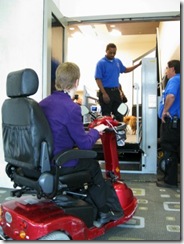
Glenda Watson Hyatt watches lift install at SXSWi 2011
(Photo credit: Sheila Scarborough)

Minutes before I was due to begin my presentation, Austin Convention Center staff wheeled in a monstrous wheelchair lift. After plugging it in and fiddling with it for several minutes, the guys decided that it might work better on the other side of the stage.

The lift was moved to the other side and fiddled with for several more minutes. Meanwhile the audience was becoming understandably restless. With so many sessions to choose from, attendees do not stay in sessions that do not capture their attention. I envisioned everyone leaving before I could get on the stage.

For some unexplainable reason the lift did not work any better on the other side and was brought back to the first side. This time the lift did go up but not down. Because I have yet to master jumping several feet with my scooter, I needed the lift to go down before going up. Obviously that was not going to happen any time soon.

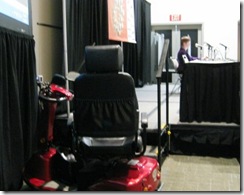
Glenda Watson Hyatt on stage with empty scooter at SXSWi 2011
(Photo credit: Sheila Scarborough)

Time for Plan B.

With only three stairs up to the stage, I suggested that, with assistance,  I could walk up onto stage. Both Becky McCray and Paul Merrill kindly offered their assistance.

On my way over to the other side of the stage, Becky offered Plan C: move the computer down so that I didn’t need to go up on stage. I considered her suggestion very briefly: Damn it, I had worked my butt off getting my presentation ready a getting to Austin. I was going to present from that stage – like everyone else.

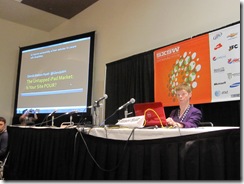
Glenda Watson Hyatt presenting on stage at SXSW 2011
(Photo credit: Paul Merrill)

The three of us made our way up the stairs and over to the waiting chair. Thankfully everyone had waited; they were engaged in the live accessibility lesson unfolding before them.

I began my presentation, many minutes late. With Becky’s, Sheila’s and Paul’s assistance during the hands-on rubber band demonstration, the session rocked despite the rocky start!

To the Austin Convention Center and other conference facilities, I offer these recommendations:

  • Keep lift equipment in good operating condition.
  • Test the equipment prior to when it is needed.
  • Train facilities staff in how to use the equipment. Offer refresher training as needed;say,before an event where the equipment is needed.
  • Keep a portable ramp on hand in the event of mechanical failure. A less than ideal way to get on stage is
  • better than no way at all.

I was able, with assistance, to get up on stage and to proceed with my presentation. Another presenter may not be able to do the same and the presentation (and all associated costs) would be lost.


Accessibility 100 is a series of 100 easy-to-implement, free and inexpensive tips for improving accessibility for people with disabilities. This is a community project. Feel free to leave your comments, questions and ideas for future Accessibility 100 posts.

Get the entire series by subscribing to the blog posts via email or by subscribing to the RSS feed.

If you enjoyed this post, consider buying me a chai tea latte. Thanks kindly.

Related Posts

Venturing How Far from One’s Comfort Zone is Safe?

Filed under: Motivation — by at 2:45 pm on Monday, April 4, 2011

Venturing beyond one’s comfort zone leads to experiencing new adventures, discovering new talents or skills, and to meeting new people. Expanding and going beyond one’s comfort zone is one way to truly live life to it’s fullest and to discover one’s full potential and capabilities.

And I am all for it!

But is there a limit to how far one should venture from the point of comfort? Is there a point at which venturing out of bounds is unsafe, unwise? Is that comfort zone there for a reason?

Yes, in recent years, I have found my way to Harpo Studios, ziplined across Robson Square, and toured Washington DC solo. However, in each case, I had taken steps for a successful outcome:

  • Using Google Maps at the most detailed level, I studied the route from Hotel 71 to Harpo Studios. I was prepared to abort the trip if I felt unsafe at any point. And, in fact, I did alter my route when the sidewalk became impassable and when the area felt less than desirable.
  • When climbing the eighty-one stairs to the zipline, the three of us took our time; I trusted my friends. I also trusted the company running the zipiine; this was their business and they would take all safety measures necessary to protect it. Rationally I knew I was safe, even though I was terrified as I sat down on the platform before leaping off into nothingness.
  • Before exploring Washington for four hours, I again studied Google Maps in great detail. And, although I didn’t put my theory to the test, I sensed yelling "Bomb!" would garner much more attention than required.

Despite similar preparation for my last trip, I felt unexplainably uneasy, scared; I even emailed my Mom that I was terrified (not the best thing to say in an email before leaving on a "foreign" trip).

Why did this trip feel so far out of my comfort zone?

I don’t know.

Perhaps it was because I was traveling alone and I realize that, as a woman with a significant physical disability, I am a vulnerable target for an assault. That is my fear, always.

Perhaps it was because the trip was three-legged – from here to Austin to San Diego and back home again – and two of those legs meant changing planes. There was more opportunity for something to go wrong.

Perhaps it was because a friend said she wouldn’t recommend that any woman stay at the motel I had booked. (At the end of my stay she realized she was thinking about the wrong motel).

Perhaps it was because of something else.

I don’t know.

But I had that feeling before I had the accessibility issues in Austin, before I missed my flight and had to unexpectedly spend the night in Phoenix, and before I had to take a taxi alone late at night in an unfamiliar city.

Was my fear my imagination running wild? Or was it trying to tell me something, to protect me from something?

How far can one safely venture from one’s comfort zone?

Technorati Tags: ,

If you enjoyed this post, consider buying me a chai tea latte. Thanks kindly.

Related Posts

« Previous PageNext Page »